Tahitian Pearls: Origin, Colors, Sizes and Value
Short answerTahitian pearls are saltwater cultured pearls grown around a shell bead in the black-lipped pearl oyster, Pinctada margaritifera, in French Polynesia, and harvested after about 18 to 24 months. Often called black pearls, they come in natural shades of gray, black and brown, most commonly greenish gray, with overtones such as blue, green, purple and pink. Under French Polynesian law, a Tahitian cultured pearl is naturally colored and untreated.
| Mollusk | Pinctada margaritifera cumingii (black-lipped pearl oyster)1 2 3 |
|---|---|
| Water | saltwater3 4 |
| Natural or cultured | cultured1 2 |
| Main producing regions | French Polynesia1 3 5 |
| Typical size | 8–14 mm4 5 6 7 |
| Size range | 8–20 mm4 5 6 7 |
| Shapes | round, oval, button, drop, circled and baroque4 6 |
| Natural colors | gray, greenish gray, black and brown3 4 6 |
| Growing time | 18–24 months6 7 |
| Nacre | Bead-cultured, with the bead placed in the gonad. French Polynesia used to require at least 0.8 mm of nacre; since its 2017 pearl law, a nacre check is voluntary.1 2 8 |
- Under CIBJO's standards and French Polynesian law, only cultured pearls grown in French Polynesia in the black-lipped pearl oyster are Tahitian cultured pearls.1 2
- Tahitian cultured pearls are harvested after about 18 to 24 months.7
- Tahitian cultured pearls are typically 8 to 14 mm. CIBJO counts 15 to 20 mm as an important size range, though production there is low.4 6
- From 2005 to 2014, French Polynesia produced an average of 12.9 tonnes of pearls a year, worth an average of US$104 million a year.9
- In French Polynesia, pearl culture is second in value only to tourism.9
- French Polynesia required at least 0.8 mm of nacre from 2005 until its 2017 pearl law made the nacre check voluntary.2 8
- A reflectance feature at 700 nm is a key identifying sign of pearls from the black-lipped pearl oyster.10
On this page
Tahitian cultured pearls are the dark saltwater pearls of French Polynesia, sometimes called black pearls.3 Like other cultured pearls, each one starts when a person implants a bead in a living oyster.
Where Tahitian pearls come from#
Tahitian pearls come from the black-lipped pearl oyster, Pinctada margaritifera, in the variety that French Polynesia’s pearl law names cumingii.2 3 It is the second largest of the pearl oysters, found across the Indo-Pacific and especially abundant in the atolls of Polynesia.9
The name is protected. CIBJO allows a place name only for pearls grown in that place, and defines a Tahitian cultured pearl as a naturally colored cultured pearl grown in French Polynesia in this oyster, around a bead inserted in its gonad.1 The same oyster is farmed in the Cook Islands, Okinawa and other Pacific islands,6 but under those rules their pearls are not Tahitian.1
In the trade, these pearls are also marketed as “black” South Sea or simply “black” cultured pearls.11
Where Tahitian pearls are farmed#
French Polynesia’s pearl farms are in the Society, Gambier and Tuamotu archipelagos.7 The oysters are grown from spat, young oysters caught on collectors in the lagoons.6
French Polynesia has produced black pearls since the mid-1970s.9 A first government trial on Bora Bora in 1961 produced good black pearls but had no commercial follow-up.12
From 2005 to 2014, French Polynesia grew an average of 12.9 tonnes of pearls a year, worth an average of US$104 million a year, and its output rose from 9 to 15 tonnes a year between 2006 and 2014.9 Pearl culture there is second in value only to tourism.9 CIBJO estimates production at about 8 million pearls a year, with a retail value of about US$230 million.6
How Tahitian pearls are grown#
A technician places a shell bead and a graft of mantle tissue in the oyster’s gonad.1 Within 14 days, the graft grows into a pearl sac that covers the bead, and the first nacre appears about 32 days after grafting.9
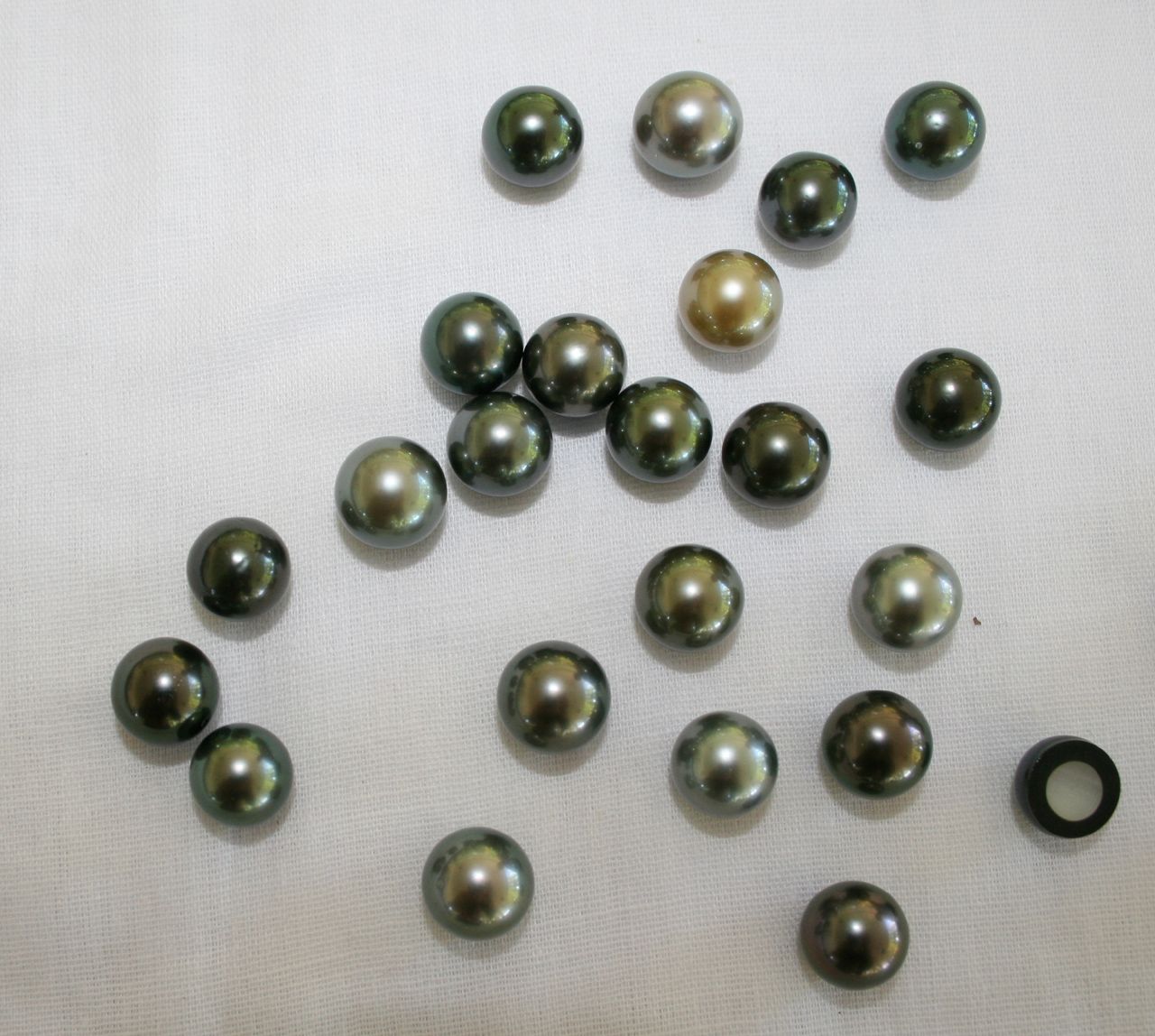

Tahitian cultured pearls are harvested after about 18 to 24 months,7 and CIBJO counts one bead-cultured pearl per oyster every two years.6 An oyster can be grafted again after a harvest, and one study found that these second-graft pearls improved in both size and shape.9
Tahitian sizes, shapes and colors#
Tahitian cultured pearls are typically 8–14 mm, within a range of 8–20 mm4, and pearls over 20 mm are rare. CIBJO says this oyster produces the largest of all black cultured pearls.6
CIBJO lists their shapes as round, oval, button, drop, circled and baroque6, and GIA says they are most often round, though any shape occurs.4
Their bodycolors are gray, greenish gray, black and brown3, and GIA names greenish gray as the most common.4 Most are shades of gray, and some are copper-colored, pistachio green or taupe. GIA says their iridescent purple, green, turquoise or pink orient is what makes them exceptional.13 CIBJO lists overtones that the trade calls peacock, green, cherry, aubergine, blue, pistachio, gold, silver and red.6
Quality factors and grading for Tahitian pearls#
Tahitian cultured pearls are judged on GIA’s seven value factors.14 A 2018 study of these pearls lists the criteria used to evaluate them as size, surface quality, luster, shape, color and darkness.7
French Polynesia’s pearl law classifies every Tahitian cultured pearl by general criteria, its size, weight, shape and surface quality, and by additional criteria such as color, assortment, pairing and nacre thickness.2 The letter grades used in the trade are a separate matter; the page AAA pearl grades explains them.
The territory required at least 0.8 mm of nacre from 2005.8 Its 2017 pearl law ended that mandatory check, and the pearl service now measures nacre thickness only on request, as a paid service.2 8
What affects the price of Tahitian pearls#
GIA’s journal notes that the most costly Tahitian pearls look black with high iridescence, but that the pearls vary greatly in color, shape and size, and so have a wide price range.12 When other factors are equal, larger pearls are rarer and more valuable.15
Identification, treatments and imitations#
Pearls from the black-lipped oyster have a reflectance feature at 700 nm that is a key identifying sign, and pearls from the related Pinctada mazatlanica share similar spectral features.10
Under French Polynesian law, a Tahitian cultured pearl must be naturally colored and untreated, and treated pearls must be labeled with the word “traitées” (treated) or the name of the treatment.2
Treated pearls from this oyster have reached the market. “Chocolate” pearls were most likely made by bleaching black cultured pearls,16 and intense “pistachio” colors have been produced by treatment, although natural pistachio-like colors also occur.17 Other dark pearls can owe their color to treatment too: some gray or blue Akoya, for example, are irradiated to darken the shell bead inside.18
Caring for Tahitian pearls#
Tahitian cultured pearls need the same care as other pearls. Put them on after perfume and cosmetics,13 wipe them with a soft cloth dampened in clean water after wearing, and keep them away from acids, solvents, heat and ultrasonic cleaners.1 The care section has the full routine.
Questions people ask#
Are black pearls natural or dyed?
Tahitian cultured pearls get their dark colors naturally, from the black-lipped oyster, and under French Polynesian law a Tahitian cultured pearl must be naturally colored and untreated. Some dark pearls are treated, though. "Chocolate" pearls were most likely made by bleaching black cultured pearls, and some gray or blue Akoya are irradiated. A GIA report records any detectable treatment.2 16 18 19
Are Tahitian pearls really from Tahiti?
They come from French Polynesia, whose best-known island is Tahiti. GIA says they are cultivated mainly around the islands of French Polynesia, and CIBJO reserves the name for cultured pearls grown there.1 3
How big are Tahitian pearls?
Typically 8 to 14 mm. CIBJO counts 15 to 20 mm as an important size range, though production there is low, and pearls over 20 mm are rare.4 6
References#
- CIBJO, The World Jewellery Confederation, Pearl Commission (2026). The CIBJO Pearl Book (Pearl Blue Book) 2026. Source · Archived copy (accessed 2026-10-25)
- Assemblée de la Polynésie française (Journal officiel de la Polynésie française) (2017). Loi du pays n° 2017-16 du 18 juillet 2017 réglementant les activités professionnelles liées à la production et la commercialisation des produits perliers et nacriers en Polynésie française. Source · Archived copy (accessed 2026-10-25)
- Gemological Institute of America (GIA), Gem Encyclopedia. Pearl Description. Source · Archived copy (accessed 2026-10-25)
- Gemological Institute of America (GIA), FAQ. What are the main types of cultured pearls and what are their distinctive characteristics?. Source · Archived copy (accessed 2026-10-25)
- Fisheries Agency of Japan (水産庁) (2026). 真珠養殖をめぐる情勢について (On the situation of pearl culture). Source · Archived copy (accessed 2026-10-25)
- CIBJO Pearl Commission (2025). CIBJO Guides Describing and Classifying Natural and Cultured Pearls, the Producing Molluscs & Responsible Pearling. Source · Archived copy (accessed 2026-10-25)
- Oïhana Latchere and others (2018). Influence of water temperature and food on the last stages of cultured pearl mineralization from the black-lip pearl oyster Pinctada margaritifera. Source · DOI 10.1371/journal.pone.0193863 · Archived copy (accessed 2026-10-25)
- Chambre territoriale des comptes de la Polynésie française (2021). Rapport d'observations définitives : Politique publique en matière des ressources marines (perliculture), exercices 2015 et suivants. Source · Archived copy (accessed 2026-10-25)
- Changbo Zhu, Paul C. Southgate and Ting Li (2019). Production of Pearls. Source · DOI 10.1007/978-3-319-96776-9_5 · Archived copy (accessed 2026-10-25)
- Artitaya Homkrajae (2016). Spectral Characteristics of Pinctada mazatlanica and Pinctada margaritifera Pearl Oyster Species. Source · Archived copy (accessed 2026-10-25)
- Stefanos Karampelas, Emmanuel Fritsch, Jean-Pierre Gauthier and Thomas Hainschwang (2011). UV-Vis-NIR Reflectance Spectroscopy of Natural-Color Saltwater Cultured Pearls from Pinctada margaritifera. Source · DOI 10.5741/GEMS.47.1.31 · Archived copy (accessed 2026-10-25)
- Russell Shor (2007). From Single Source to Global Free Market: The Transformation of the Cultured Pearl Industry. Source · DOI 10.5741/GEMS.43.3.200 · Archived copy (accessed 2026-10-25)
- Gemological Institute of America (GIA), Gem Encyclopedia. Pearl Buyer's Guide. Source · Archived copy (accessed 2026-10-25)
- Gemological Institute of America (GIA), Analysis & Grading. How GIA Identifies and Classifies Pearls. Source · Archived copy (accessed 2026-10-25)
- Gemological Institute of America (GIA), Gem Encyclopedia. Pearl Quality Factors. Source · Archived copy (accessed 2026-10-25)
- Wuyi Wang, Kenneth Scarratt, Akira Hyatt, Andy Hsi-Tien Shen and Matthew Hall (2006). Identification of "Chocolate Pearls" Treated by Ballerina Pearl Co.. Source · DOI 10.5741/GEMS.42.4.222 · Archived copy (accessed 2026-10-25)
- Chunhui Zhou, Joyce Wing Yan Ho, Sally Chan, Jessie Yixin Zhou, Surjit Dillon Wong and Kyaw Soe Moe (2016). Identification of "Pistachio" Colored Pearls Treated by Ballerina Pearl Co.. Source · DOI 10.5741/GEMS.52.1.50 · Archived copy (accessed 2026-10-25)
- Emiko Yazawa and Chunhui Zhou (2024). Irradiated and Dyed Akoya Pearls. Source · Archived copy (accessed 2026-10-25)
- Phoebe Shang (2026). Freshwater Akoyas – A Trending Misnomer for Certain Freshwater Pearls. Source · Archived copy (accessed 2026-10-25)
- Written by
- Learn About Pearls editors
- Fact-checked
- Learn About Pearls editors,
- Reviewed by
- Simon,
- First published
- Publisher
- Unique Pearl, a pearl jeweler
Revision history
- : First published. First published
How to cite this page
- APA
- Learn About Pearls editors. (2026). Tahitian Pearls: Origin, Colors, Sizes and Value. Learn About Pearls. https://learnaboutpearls.com/types/tahitian-pearls/
- MLA
- “Tahitian Pearls: Origin, Colors, Sizes and Value.” Learn About Pearls, Unique Pearl, November 4, 2026, learnaboutpearls.com/types/tahitian-pearls/.
- Chicago
- Learn About Pearls editors. “Tahitian Pearls: Origin, Colors, Sizes and Value.” Learn About Pearls. Unique Pearl. Last modified November 4, 2026. https://learnaboutpearls.com/types/tahitian-pearls/.
- BibTeX
@misc{lap-types-tahitian-pearls, title = {Tahitian Pearls: Origin, Colors, Sizes and Value}, author = {{Learn About Pearls editors}}, year = {2026}, howpublished = {\url{https://learnaboutpearls.com/types/tahitian-pearls/}}, note = {Learn About Pearls, published by Unique Pearl}}
Quoting with attribution and a link is welcome. See how to cite and reuse.