What Are Natural Pearls, and How Rare Are They?
Short answerNatural pearls are pearls that formed inside a mollusk with no human help of any kind, usually around a microscopic irritant. They are rare: hundreds of pearl oysters or mussels must be opened to find even one, and perfectly round natural pearls are extremely rare. Because cultured pearls can look the same, a gem laboratory confirms that a pearl is natural, mainly with X-ray imaging of its inner structure.
On this page
For most of history, every pearl was a natural pearl. This section covers what makes a pearl natural, where natural pearls came from, and how they are identified today.
What makes a pearl natural#
A natural pearl forms in the body, or the mantle tissue, of certain mollusks, always without human help of any kind.1 CIBJO, the international jewelry confederation, defines it as a pearl secreted in a naturally formed pearl sac, and natural pearls can be nacreous or non-nacreous.2
In the United States, the word “pearl” on its own means a natural pearl: one whose formation was in no way caused or induced by humans.3 Any other pearl must carry a qualifying word such as “cultured” or “imitation”.
How rare natural pearls are#
Hundreds of pearl oysters or mussels must be gathered and opened to find even one natural pearl, and perfectly spherical natural pearls are extremely rare and highly valuable.4 In 2018, Marie Antoinette’s 18th-century natural pearl and diamond pendant sold at auction for CHF 36,427,000, a record for a natural pearl.5
Where natural pearls came from#
Until 1492, some of the main sources of natural pearls were the Persian Gulf, the waters off Sri Lanka, the rivers and lakes of China and the rivers of Europe.6 On his voyages of 1498 and 1502, Christopher Columbus met people wearing pearls, and pearl beds off present-day Venezuela and Panama raised demand in Europe.6
From 1850 to 1930, the peak of pearl fishing in the Persian Gulf, the Gulf supplied perhaps 70–80% of the world’s natural pearls, and Bahrain was the center of the trade.7
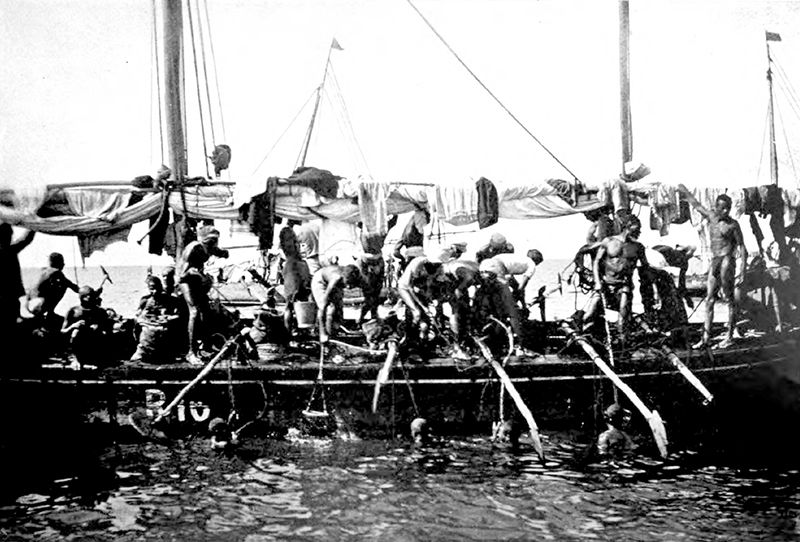

- 1498: Columbus meets people wearing pearls on his third voyage. On his third (1498) and fourth (1502) voyages, Christopher Columbus met people adorned with natural pearls. The pearl sources he found, in present-day Venezuela and Panama, raised demand in Europe.2 6
- 1925: Gem testing laboratories open to separate natural from cultured pearls. The London Chamber of Commerce opened a gem testing laboratory in 1925, followed by the Laboratoire Français de Gemmologie in 1929 and GIA in 1931. All three first focused on telling natural pearls from cultured ones.8
- 1930s: The Gulf's natural pearl trade contracts. From 1850 to 1930 the Persian Gulf supplied perhaps 70–80% of the world's natural pearls. From the 1930s the natural pearl market contracted, because of the Great Depression, the discovery of oil in the Gulf and the arrival of cultured pearls.7 9
- 2018-11-14: Marie Antoinette's natural pearl pendant sets an auction record. At Sotheby's in Geneva, Marie Antoinette's 18th-century natural pearl and diamond pendant sold for CHF 36,427,000, a new auction record for a natural pearl.5
How labs confirm a natural pearl#
A gem lab separates natural from cultured pearls mainly by X-ray imaging. A natural pearl shows no bead or curved cavity at its center, and a uniform, onion-like structure.4 SSEF’s reports distinguish natural from cultured pearls, and beaded from beadless cultured pearls.10
Testing matters because some cultured pearls look natural. In 2010, SSEF warned that beadless cultured pearls from South Sea oysters, some sold with reports describing them as natural, were entering the natural pearl trade.11 It identified them with X-ray radiography, X-ray luminescence, X-ray microtomography and radiocarbon dating.11
Labs also weigh natural pearls differently. GIA and SSEF weigh a loose natural pearl in carats and in grains, where 1 grain is 0.25 carat, and a loose cultured pearl in carats only.10 12
Every page in this section#
Pages for this section are being written.
References#
- Gemological Institute of America (GIA), Gem Encyclopedia. Pearl Description. Source · Archived copy (accessed 2026-10-25)
- CIBJO, The World Jewellery Confederation, Pearl Commission (2026). The CIBJO Pearl Book (Pearl Blue Book) 2026. Source · Archived copy (accessed 2026-10-25)
- U.S. Federal Trade Commission (Electronic Code of Federal Regulations). 16 CFR Part 23, Guides for the Jewelry, Precious Metals, and Pewter Industries. Source · Archived copy (accessed 2026-10-25)
- Changbo Zhu, Paul C. Southgate and Ting Li (2019). Production of Pearls. Source · DOI 10.1007/978-3-319-96776-9_5 · Archived copy (accessed 2026-10-25)
- Sotheby's (2018). Marie Antoinette's Pearls Break Auction Records in Geneva. Source · Archived copy (accessed 2026-10-25)
- Gemological Institute of America (GIA), Gem Encyclopedia. Pearl History and Lore. Source · Archived copy (accessed 2026-10-25)
- GIA staff (2025). Converge 2025 Speaker Presentations. Source · Archived copy (accessed 2026-10-25)
- Chunhui Zhou and W. Henry Towbin (2024). Applications of X-Ray Radiography and X-Ray Computed Microtomography in Gemology. Source · DOI 10.5741/GEMS.60.4.582 · Archived copy (accessed 2026-10-25)
- CIBJO, The World Jewellery Confederation (2021). CIBJO Retailers' Reference Guide: Pearls. Source · Archived copy (accessed 2026-10-25)
- Swiss Gemmological Institute SSEF. Pearls (SSEF reports). Source · Archived copy (accessed 2026-10-25)
- Michael S. Krzemnicki (2010). Trade Alert: "Keshi" cultured pearls are entering the natural pearl trade. Source · Archived copy (accessed 2026-10-25)
- Gemological Institute of America (GIA), Analysis & Grading. How GIA Identifies and Classifies Pearls. Source · Archived copy (accessed 2026-10-25)
- Written by
- Learn About Pearls editors
- Fact-checked
- Learn About Pearls editors,
- Reviewed by
- Simon,
- First published
- Publisher
- Unique Pearl, a pearl jeweler
Revision history
- : First published. First published
How to cite this page
- APA
- Learn About Pearls editors. (2026). What Are Natural Pearls, and How Rare Are They? Learn About Pearls. https://learnaboutpearls.com/natural-pearls/
- MLA
- “What Are Natural Pearls, and How Rare Are They?” Learn About Pearls, Unique Pearl, November 4, 2026, learnaboutpearls.com/natural-pearls/.
- Chicago
- Learn About Pearls editors. “What Are Natural Pearls, and How Rare Are They?” Learn About Pearls. Unique Pearl. Last modified November 4, 2026. https://learnaboutpearls.com/natural-pearls/.
- BibTeX
@misc{lap-natural-pearls, title = {What Are Natural Pearls, and How Rare Are They?}, author = {{Learn About Pearls editors}}, year = {2026}, howpublished = {\url{https://learnaboutpearls.com/natural-pearls/}}, note = {Learn About Pearls, published by Unique Pearl}}
Quoting with attribution and a link is welcome. See how to cite and reuse.