What Are Baroque Pearls?
Short answerA baroque pearl is a natural or cultured pearl with an irregular shape; the word was first a French adjective for things that were not symmetrical. A cultured pearl grows off-round when its pearl sac lays down nacre unevenly, and the longer it grows, the likelier that becomes. Round is the hardest shape to culture, but well-formed baroque pearls are prized too, and designers like large pearls with unusual shapes.
- CIBJO defines a baroque pearl as an irregularly shaped natural or cultured pearl.1
- Baroque was originally a French adjective for objects or pearls that were not symmetrical in shape.1
- GIA lists eight basic pearl shapes, round, semi-round, button, drop, pear, oval, baroque and circled.2
- A circled pearl has one or more concentric rings or indented grooves around it.1
- A cultured pearl can grow off-round even on a perfectly round bead, and the longer the culture lasts, the more off-round pearls there are.3
- Round is the rarest cultured pearl shape, but well-formed pear, oval and baroque cultured pearls are also prized.4
- Larger pearls with unusual shapes are popular with creative jewelry designers.5
On this page
A baroque pearl is one with an irregular shape. The word describes the shape, not a kind of pearl, so a baroque pearl can be a natural pearl or a cultured pearl of any type.1
What makes a pearl baroque#
CIBJO, the international jewelry confederation, defines a baroque pearl as an irregularly shaped natural or cultured pearl, and notes that baroque was originally a French adjective for objects or pearls that were not symmetrical.1
Baroque is one of eight basic shapes that GIA lists: round, semi-round, button, drop, pear, oval, baroque and circled.2 CIBJO divides pearl shapes more broadly, into round, near-round, oval, button, drop and baroque.1 Some classifications add a step before baroque: the one for Japanese Akoya cultured pearls in CIBJO’s guide grades shape as round, semi-round or oval, semi-baroque, or baroque.3
Old pearling regions have names of their own. In the Arabian Gulf, natural pearls are classified locally as dana, perfectly round and over 7 mm; sijni or dam’ah, drop-shaped; batan, button-shaped; baythawi, oval; and emtaaz, baroque.1
Text version of this diagram
Eight outlines in two rows. Round is a perfect circle and semi-round a circle just slightly out of true. Button is seen from the side, a dome with a flat base. Drop is a teardrop with a pointed top. Pear is rounded at both ends, narrower at the top than the bottom. Oval is an upright ellipse. Baroque is an irregular, lumpy outline with no symmetry. Circled is an oval crossed by two curved grooves running around it.
Why pearls grow off-round#
Even a perfectly round bead doesn’t guarantee a round pearl. CIBJO’s guide explains that a cultured pearl grows out of shape when its pearl sac doesn’t lay down nacre evenly over the bead, or when organic matter is trapped in the nacre, and that the longer the culture lasts and the thicker the nacre grows, the more off-round pearls there are.3
The operation matters too. In Akoya culture, a badly damaged oyster, slow healing or cell debris caught between the bead and the pearl sac can distort the sac, causing bumps and distortions, and thin nacre often results in baroque pearls with blue or gray tints.3
How a pearl is started also shapes it. GIA’s journal notes that most Chinese farmers implant their mussels with pieces of mantle tissue only, without beads, which yields primarily baroque pearls and occasionally round ones.6 And keshi, which form without a bead as a by-product of culturing, are essentially baroque.1
Circled pearls#
A circled pearl, also called cerclé, has one or more concentric rings or indented grooves around it.1 Circled is one of GIA’s eight basic shapes.2 CIBJO’s guide lists it among the shapes of the South Sea cultured pearls of Indonesia, Myanmar and Vietnam, and of Tahitian cultured pearls.3
Shapes by type#
Every main type can produce baroque pearls. The table gives the shapes recorded for each one in the Learn About Pearls dataset.
| Feature | Akoya cultured pearl | Freshwater cultured pearl | South Sea cultured pearl | Tahitian cultured pearl |
|---|---|---|---|---|
| Shapes | round, near-round, semi-baroque and baroque3 7 | round, near-round, oval, coin and baroque3 8 9 | round, oval, button, drop, circled and baroque3 9 | round, oval, button, drop, circled and baroque3 9 |
Value and uses#
Shape affects value. Round is the most difficult shape to culture, which makes round cultured pearls rarer than any other shape and, all else being equal, generally worth more. GIA adds that well-formed pear, oval and baroque cultured pearls are also prized.4 GIA’s buyer’s guide adds that perfectly spherical pearls and symmetrical drops are valued most.2
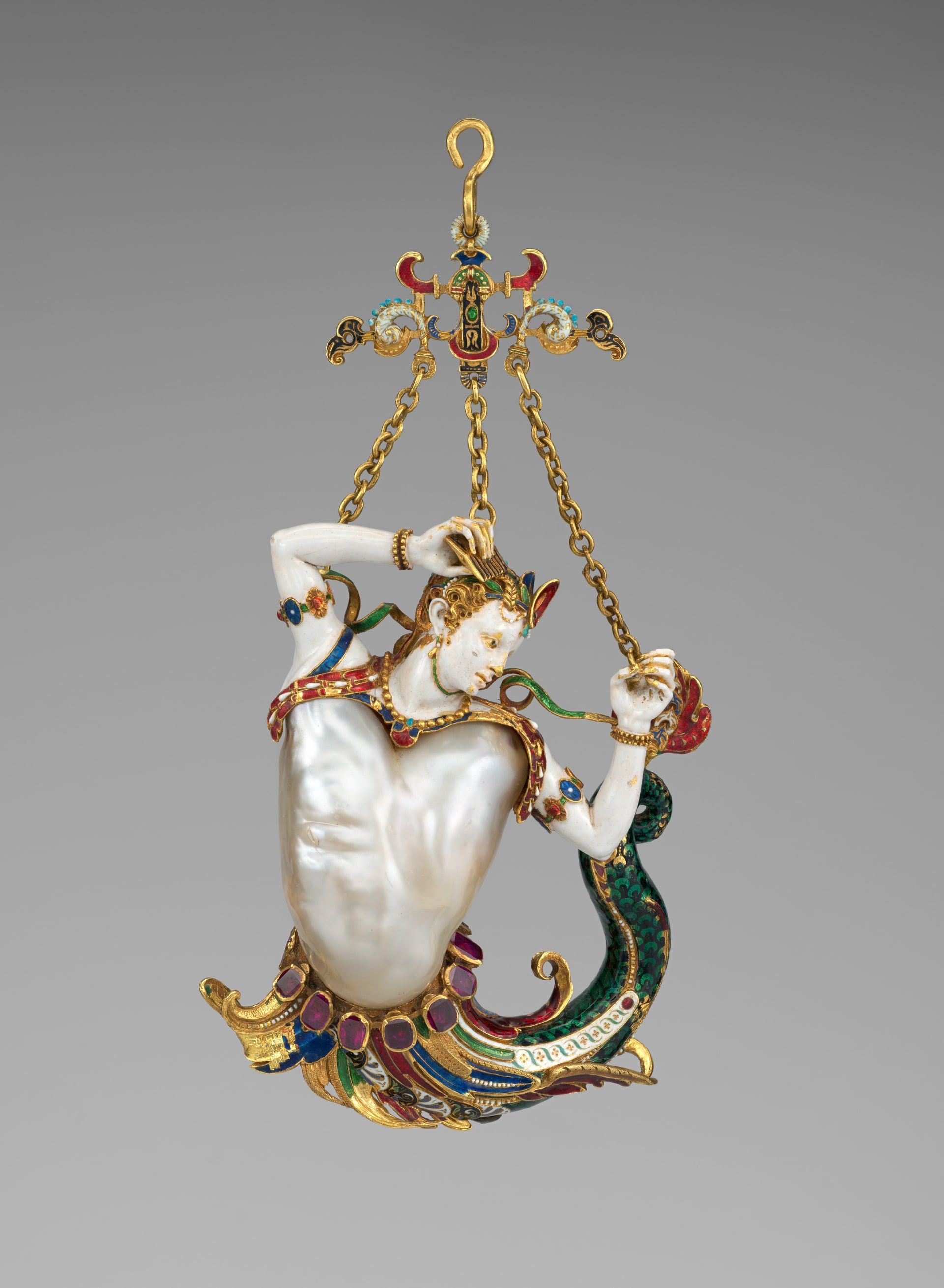
Baroque pearls have their own following. GIA notes that larger pearls with unusual shapes are popular with creative jewelry designers,5 and that designers sometimes mix shapes in one piece on purpose.4
Imitation pearls struggle to copy them. In GIA’s 1990 study of Majorica imitation pearls, only a limited number of baroque shapes were made, because they are harder to manufacture, and they could not compete on price with many cultured freshwater baroques.10 Any imitation, baroque or round, must be described as an imitation in the United States.11 The page real vs imitation pearls explains how to tell them apart.
Questions people ask#
Are baroque pearls real pearls?
Yes. Baroque describes a shape, not a kind of pearl, and CIBJO defines a baroque pearl as an irregularly shaped natural or cultured pearl. Imitation pearls are made in some baroque shapes too, but in the United States they must be called imitations.1 10 11
Are baroque pearls worth less than round ones?
When all other factors are equal, round cultured pearls are generally the most valuable, because round is the hardest shape to culture. But GIA notes that well-formed pear, oval and baroque cultured pearls are also prized.4
What are circled pearls?
Pearls with one or more concentric rings or indented grooves around them, also called cerclé. Circled is one of GIA's eight basic shapes, and South Sea and Tahitian cultured pearls are among the types that come in it.1 2 3
Why are so many freshwater pearls baroque?
Because of how most are grown. GIA's journal notes that most Chinese farmers implant their mussels with pieces of mantle tissue only, no bead, which yields primarily baroque pearls and occasionally rounds.6
What is a semi-baroque pearl?
A shape grade between semi-round and baroque. The classification for Japanese Akoya cultured pearls in CIBJO's guide uses four shape grades, in this order, round, semi-round or oval, semi-baroque and baroque.3
References#
- CIBJO, The World Jewellery Confederation, Pearl Commission (2026). The CIBJO Pearl Book (Pearl Blue Book) 2026. Source · Archived copy (accessed 2026-10-25)
- Gemological Institute of America (GIA), Gem Encyclopedia. Pearl Buyer's Guide. Source · Archived copy (accessed 2026-10-25)
- CIBJO Pearl Commission (2025). CIBJO Guides Describing and Classifying Natural and Cultured Pearls, the Producing Molluscs & Responsible Pearling. Source · Archived copy (accessed 2026-10-25)
- Gemological Institute of America (GIA), Gem Encyclopedia. Pearl Quality Factors. Source · Archived copy (accessed 2026-10-25)
- Gemological Institute of America (GIA), Gem Encyclopedia. Pearl Description. Source · Archived copy (accessed 2026-10-25)
- Russell Shor (2007). From Single Source to Global Free Market: The Transformation of the Cultured Pearl Industry. Source · DOI 10.5741/GEMS.43.3.200 · Archived copy (accessed 2026-10-25)
- Areeya Manustrong (2018). Very Small Akoya Cultured Pearls. Source · Archived copy (accessed 2026-10-25)
- Shigeru Akamatsu, Li Tajima Zansheng, Thomas M. Moses and Kenneth Scarratt (2001). The Current Status of Chinese Freshwater Cultured Pearls. Source · DOI 10.5741/GEMS.37.2.96 · Archived copy (accessed 2026-10-25)
- Gemological Institute of America (GIA), FAQ. What are the main types of cultured pearls and what are their distinctive characteristics?. Source · Archived copy (accessed 2026-10-25)
- June Hanano, Mary Wildman and Philip G. Yurkiewicz (1990). Majorica Imitation Pearls. Source · DOI 10.5741/GEMS.26.3.178 · Archived copy (accessed 2026-10-25)
- U.S. Federal Trade Commission (Electronic Code of Federal Regulations). 16 CFR Part 23, Guides for the Jewelry, Precious Metals, and Pewter Industries. Source · Archived copy (accessed 2026-10-25)
- Written by
- Learn About Pearls editors
- Fact-checked
- Learn About Pearls editors,
- Reviewed by
- Simon,
- First published
- Publisher
- Unique Pearl, a pearl jeweler
Revision history
- : First published. First published
How to cite this page
- APA
- Learn About Pearls editors. (2026). What Are Baroque Pearls? Learn About Pearls. https://learnaboutpearls.com/types/baroque-pearls/
- MLA
- “What Are Baroque Pearls?” Learn About Pearls, Unique Pearl, November 4, 2026, learnaboutpearls.com/types/baroque-pearls/.
- Chicago
- Learn About Pearls editors. “What Are Baroque Pearls?” Learn About Pearls. Unique Pearl. Last modified November 4, 2026. https://learnaboutpearls.com/types/baroque-pearls/.
- BibTeX
@misc{lap-types-baroque-pearls, title = {What Are Baroque Pearls?}, author = {{Learn About Pearls editors}}, year = {2026}, howpublished = {\url{https://learnaboutpearls.com/types/baroque-pearls/}}, note = {Learn About Pearls, published by Unique Pearl}}
Quoting with attribution and a link is welcome. See how to cite and reuse.