Akoya Pearls: Origin, Sizes, Quality and Value
Short answerAkoya pearls are saltwater cultured pearls grown in the Akoya pearl oyster, Pinctada fucata, mostly in Japan, with smaller amounts from China and Vietnam. Each oyster grows one pearl around a shell bead, typically for 10 to 14 months. Most are round and white or cream, about 6 to 8 mm across, with a sharp, mirror-like shine. They generally cost more than freshwater cultured pearls of similar size and quality.
| Mollusk | Pinctada fucata (Akoya pearl oyster)1 2 |
|---|---|
| Water | saltwater2 3 |
| Natural or cultured | cultured1 |
| Main producing regions | Japan, China and Vietnam2 4 5 |
| Typical size | 6–8 mm3 4 5 6 7 |
| Size range | 2–11 mm3 4 5 6 7 |
| Shapes | round, near-round, semi-baroque and baroque5 6 |
| Natural colors | white and cream2 3 5 7 |
| Growing time | 6–36 months (typically 10 to 14 months)4 5 6 |
| Nacre | Bead-cultured, so the nacre covers a shell bead. Akoya nacre is generally thinner than that of South Sea and Tahitian cultured pearls, because the growing period is shorter and the water cooler.1 8 9 |
| Relative price | Generally more expensive than freshwater cultured pearls of similar size and quality (GIA)2 |
- Japan's pearl farms, which grow mostly Akoya, have produced about 12 tonnes of pearls a year since 2021, after a virus-linked die-off of oysters that began in 2019.4
- Akoya cultured pearls range from about 2 to 11 mm and are most often 6 to 8 mm. Pearls over 10 mm are rare, though GIA has documented strands of 11.0 to 12.2 mm.6 7
- A shell bead and a small piece of donor mantle tissue go into each oyster's gonad, and the oyster is typically left in the water for 10 to 14 months.6
- Japan's main Akoya-growing prefectures are Nagasaki, Ehime and Mie.4
- Akoya nacre is generally thinner than South Sea or Tahitian nacre. In one X-ray image GIA published, a 6.85 mm Akoya had about 0.34 mm of nacre.8 9
- CIBJO puts the retail value of the world's Akoya production at about US$130 million a year.5
On this page
Akoya cultured pearls are the small, white saltwater pearls most people picture when they think of pearls, and the classic choice for a single strand.3 10
Where Akoya pearls come from#
Akoya pearls come from the Akoya pearl oyster, Pinctada fucata, which in Japan is also called P. martensii. Akoya is the Japanese name for the oyster, and CIBJO defines an Akoya cultured pearl as a beaded cultured pearl grown in it.1 The oyster’s natural range runs from Japan to China and Vietnam.1
Akoya oysters gave the world its first round cultured pearls.5 Kokichi Mikimoto cultured hemispherical pearls in 1893, and the technique for whole, round cultured pearls dates from 1907.11 The method came from Tatsuhei Mise and Tokichi Nishikawa, and Mikimoto’s company built its brand on round, pink-to-white Akoya.12 The page who invented cultured pearls tells that story.
Where Akoya pearls are farmed#
Japan grows most Akoya cultured pearls, and its main producing prefectures are Nagasaki, Ehime and Mie. China and Vietnam produce smaller amounts, and South Korea a little.4 CIBJO also lists Australia as a newer producer.5
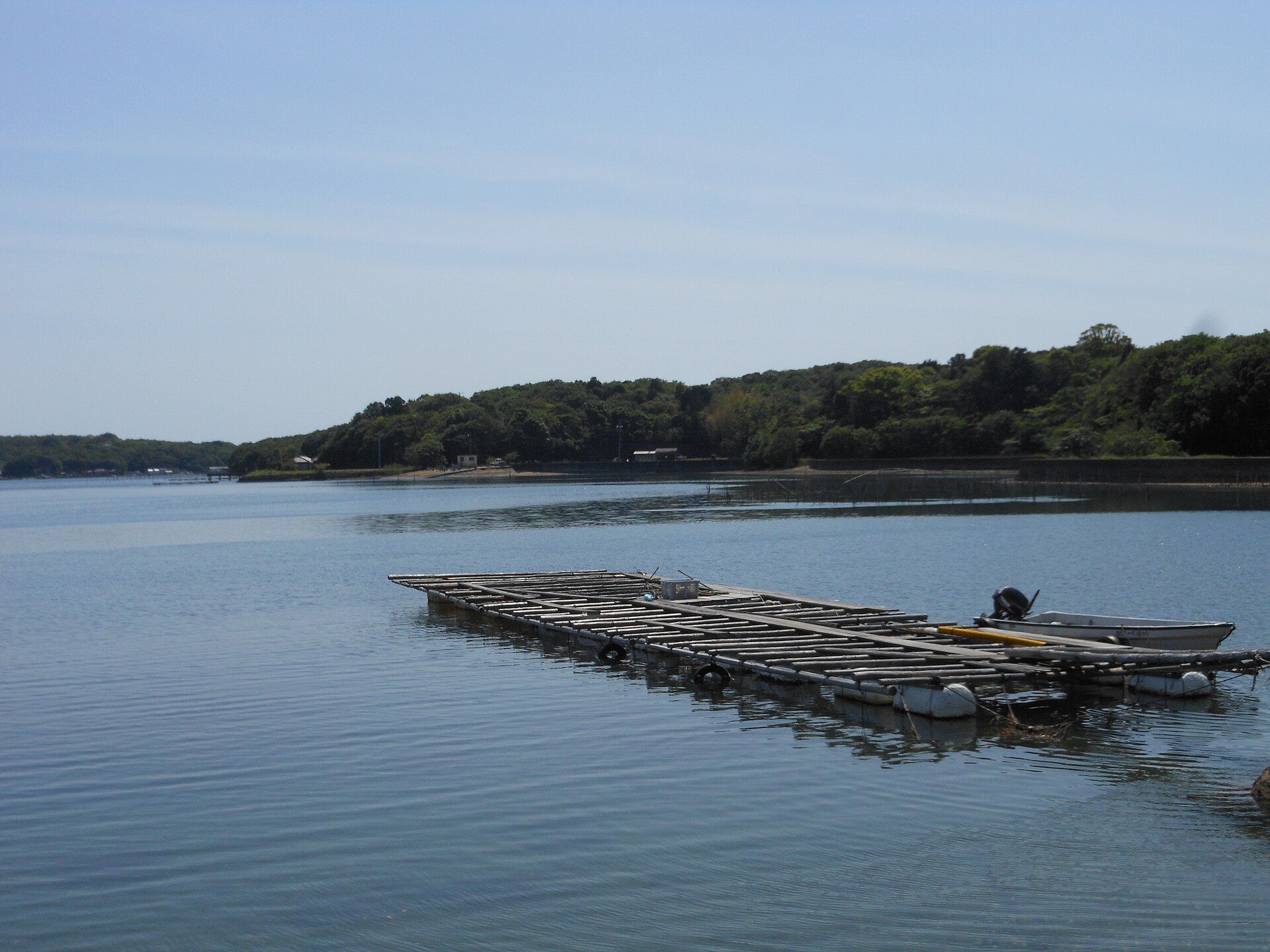

Japanese Akoya production has fallen over the decades. A new kind of red tide in Ago Bay in 1994, and infectious disease, caused a significant decline.5 From 2019 a virus-linked mass die-off of oysters hit the farms, mainly in Ehime and Mie, and since 2021 Japan’s pearl farms have produced about 12 tonnes a year.4
Prices rose as output fell and demand grew, led by China. Japan’s 2024 pearl harvest was worth 33.5 billion yen.4
How Akoya pearls are grown#
Akoya oysters are mostly bred in hatcheries and raised for 2 to 3 years before they receive a bead.5 A technician then places a shell bead and a small piece of mantle tissue from a donor oyster in each oyster’s gonad.6 Each oyster grows one pearl at a time.13
After about a month of recovery, the main culture lasts from half a year to a year and a half, and some pearls are harvested after less than six months.4 GIA says Akoya oysters are typically left in the water for 10 to 14 months.6 Across these sources, the dataset gives a growing time of 6–36 months (typically 10 to 14 months)4.
Farmers prefer to harvest Akoya in winter. Cold water slows nacre growth, so the layers form more tightly and the pearls come out with the highest luster.6
Akoya sizes, shapes and colors#
Akoya cultured pearls are typically 6–8 mm, within a range of 2–11 mm6. Pearls over 10 mm are rare.7 GIA has also documented two strands of unusually large Akoya, with the biggest pearl measuring 12.2 mm.7
CIBJO lists Akoya shapes as round, near-round, semi-baroque and baroque5, and GIA says Akoya are typically round.6
Akoya colors are white and cream, often with a pink overtone.3 That pink is very often the result of processing.7
Quality factors for Akoya pearls#
Akoya cultured pearls are judged on the seven value factors GIA uses for saltwater cultured pearls: size, shape, color, luster, surface, nacre and matching. Akoya are known for their luster, and GIA describes them as famed for a mirror-like shine.2
Nacre is the factor to watch. Akoya nacre is generally thinner than South Sea or Tahitian nacre, because the oysters grow for a shorter time in cooler water.8 A bead visible under the nacre, or a dull, chalky look, means thin nacre, which hurts both luster and durability.14
Thin nacre has been a problem before. In the 1990s, when some producers harvested as little as six months after implanting the bead, complaints of nacre peeling from pearls with coatings under 0.2 mm surfaced, largely in Japan.12
How Akoya pearls are graded#
GIA’s Pearl Identification and Classification Report covers Akoya cultured pearls. It records the pearls’ identity, their environment, the mollusk when it can be determined and any detectable treatments, and it grades the pearls on GIA’s seven value factors.2
Color names vary from seller to seller. CIBJO notes that there are no unified standards for pearl color names, and that each vendor uses its own; pink, white, green, cream, gold and blue are names commonly used for Akoya.5
What affects the price of Akoya pearls#
Akoya cultured pearls cost more than freshwater cultured pearls of similar size and quality, in part because they are rarer and cost more to culture.2 Within Akoya, size matters. When the other factors are equal, larger pearls are rarer and more valuable,14 and Akoya over 10 mm are rare.7
Supply also moves the price. Lower Japanese harvests since 2019, together with demand led by China, have pushed up the price per pearl.4
Identification, treatments and imitations#
Akoya cultured pearls are bead-cultured, so X-ray imaging shows a clear line between the shell bead and the nacre, and labs can measure the nacre’s thickness.9
Bead-cultured freshwater pearls can look much like Akoya, because they are often near-round to round, bright white and very lustrous. Sellers sometimes call them “Chinese Akoya”, “baby Akoya” or “freshwater Akoya”, but they are not Akoya pearls. Freshwater pearls often show a very slight flat side, though looking alone is often not enough to tell them apart.2 Labs separate them by chemistry: freshwater pearls contain more manganese and barium and less strontium than saltwater pearls.15
Treatments are common in Akoya. Bleaching is common, and many Akoya are routinely treated for luster and an even color.5 Some gray or blue Akoya have been irradiated, which darkens the freshwater shell bead inside and changes the pearl’s color. Signs include color concentrated around the drill hole.16
Imitations are a separate matter. In the United States an imitation pearl must be called “imitation”, “artificial” or “simulated”, in letters as clear as the word “pearl”.17
Caring for Akoya pearls#
Akoya cultured pearls need the same care as other pearls. CIBJO’s care advice for all natural and cultured pearls is to handle them gently and store each piece separately, so nothing scratches them. Put on cosmetics before your pearls, not after. After wearing them, wipe them with a soft cloth dampened in clean water, and don’t wrap them in materials that absorb moisture, such as cotton wool.1
Keep pearls away from solvents, acids and high heat, never put them in an ultrasonic cleaner, and take them off for heavy work. Some color-treated pearls can fade or revert to their original color under strong light.1 Nacre quality also affects how well Akoya wear, because thin nacre reduces durability.14
Questions people ask#
Are Mikimoto pearls Akoya pearls?
Mikimoto is a jewelry brand, not a type of pearl. It grew from the business of Kokichi Mikimoto, the Japanese pioneer of cultured pearls, and GIA's journal says the Mikimoto name became synonymous with round, pink-to-white Akoya cultured pearls. A lab report can state which oyster a pearl came from, when that can be determined.2 12
Where do Akoya pearls come from?
Most come from Japan, mainly Nagasaki, Ehime and Mie prefectures. China and Vietnam produce smaller amounts and South Korea a little, and CIBJO lists Australia as a newer producer.4 5
Are "freshwater Akoya" pearls real Akoya?
No. Pearls sold as "freshwater Akoya", "Chinese Akoya" or "baby Akoya" are bead-cultured freshwater pearls from mussels. GIA calls the name misleading, because Akoya cultured pearls come from the saltwater Akoya oyster.1 2
References#
- CIBJO, The World Jewellery Confederation, Pearl Commission (2026). The CIBJO Pearl Book (Pearl Blue Book) 2026. Source · Archived copy (accessed 2026-10-25)
- Phoebe Shang (2026). Freshwater Akoyas – A Trending Misnomer for Certain Freshwater Pearls. Source · Archived copy (accessed 2026-10-25)
- Gemological Institute of America (GIA), FAQ. What are the main types of cultured pearls and what are their distinctive characteristics?. Source · Archived copy (accessed 2026-10-25)
- Fisheries Agency of Japan (水産庁) (2026). 真珠養殖をめぐる情勢について (On the situation of pearl culture). Source · Archived copy (accessed 2026-10-25)
- CIBJO Pearl Commission (2025). CIBJO Guides Describing and Classifying Natural and Cultured Pearls, the Producing Molluscs & Responsible Pearling. Source · Archived copy (accessed 2026-10-25)
- Areeya Manustrong (2018). Very Small Akoya Cultured Pearls. Source · Archived copy (accessed 2026-10-25)
- Artitaya Homkrajae (2024). Remarkably Large Akoya Bead Cultured Pearls. Source · Archived copy (accessed 2026-10-25)
- Kwanreun Lawanwong, Ravenya Atchalak and Emiko Yazawa (2025). Exceptional Nacre Thickness of Hybrid Akoya Bead Cultured Pearls. Source · Archived copy (accessed 2026-10-25)
- Chunhui Zhou and W. Henry Towbin (2024). Applications of X-Ray Radiography and X-Ray Computed Microtomography in Gemology. Source · DOI 10.5741/GEMS.60.4.582 · Archived copy (accessed 2026-10-25)
- Gemological Institute of America (GIA), Gem Encyclopedia. Pearl Description. Source · Archived copy (accessed 2026-10-25)
- CIBJO, The World Jewellery Confederation (2021). CIBJO Retailers' Reference Guide: Pearls. Source · Archived copy (accessed 2026-10-25)
- Russell Shor (2007). From Single Source to Global Free Market: The Transformation of the Cultured Pearl Industry. Source · DOI 10.5741/GEMS.43.3.200 · Archived copy (accessed 2026-10-25)
- Changbo Zhu, Paul C. Southgate and Ting Li (2019). Production of Pearls. Source · DOI 10.1007/978-3-319-96776-9_5 · Archived copy (accessed 2026-10-25)
- Gemological Institute of America (GIA), Gem Encyclopedia. Pearl Quality Factors. Source · Archived copy (accessed 2026-10-25)
- Stefanos Karampelas and others (2019). Chemical Characteristics of Freshwater and Saltwater Natural and Cultured Pearls from Different Bivalves. Source · DOI 10.3390/min9060357 · Archived copy (accessed 2026-10-25)
- Emiko Yazawa and Chunhui Zhou (2024). Irradiated and Dyed Akoya Pearls. Source · Archived copy (accessed 2026-10-25)
- U.S. Federal Trade Commission (Electronic Code of Federal Regulations). 16 CFR Part 23, Guides for the Jewelry, Precious Metals, and Pewter Industries. Source · Archived copy (accessed 2026-10-25)
- Written by
- Learn About Pearls editors
- Fact-checked
- Learn About Pearls editors,
- Reviewed by
- Simon,
- First published
- Publisher
- Unique Pearl, a pearl jeweler
Revision history
- : First published. First published
How to cite this page
- APA
- Learn About Pearls editors. (2026). Akoya Pearls: Origin, Sizes, Quality and Value. Learn About Pearls. https://learnaboutpearls.com/types/akoya-pearls/
- MLA
- “Akoya Pearls: Origin, Sizes, Quality and Value.” Learn About Pearls, Unique Pearl, November 4, 2026, learnaboutpearls.com/types/akoya-pearls/.
- Chicago
- Learn About Pearls editors. “Akoya Pearls: Origin, Sizes, Quality and Value.” Learn About Pearls. Unique Pearl. Last modified November 4, 2026. https://learnaboutpearls.com/types/akoya-pearls/.
- BibTeX
@misc{lap-types-akoya-pearls, title = {Akoya Pearls: Origin, Sizes, Quality and Value}, author = {{Learn About Pearls editors}}, year = {2026}, howpublished = {\url{https://learnaboutpearls.com/types/akoya-pearls/}}, note = {Learn About Pearls, published by Unique Pearl}}
Quoting with attribution and a link is welcome. See how to cite and reuse.