South Sea Pearls: Origin, Colors, Sizes and Value
Short answerSouth Sea pearls are saltwater cultured pearls grown in Pinctada maxima, the largest pearl oyster, mainly in Australia, Indonesia, the Philippines and Myanmar. Each oyster grows one pearl around a shell bead over one to three years, which gives them thick nacre. They are the largest cultured pearls, typically 9 to 16 mm, and come in white, silver, cream and golden colors.
| Mollusk | Pinctada maxima (silver-lipped pearl oyster and gold-lipped pearl oyster)1 2 |
|---|---|
| Water | saltwater3 4 |
| Natural or cultured | cultured1 |
| Main producing regions | Australia, Indonesia, the Philippines and Myanmar1 2 3 5 |
| Typical size | 9–16 mm4 5 6 |
| Size range | 8–18 mm4 5 6 |
| Shapes | round, oval, button, drop, circled and baroque4 6 |
| Natural colors | white, silver, cream, champagne and golden3 6 7 8 9 |
| Growing time | 1–3 years (two to three years in Australia and the Philippines)2 6 |
| Nacre | Bead-cultured, with the thickest nacre of the bead-cultured types, typically 1.5–3.0 mm.2 10 |
- Australia is the largest producer of white South Sea cultured pearls, while Indonesia, Myanmar and the Philippines are major producers of golden ones.2
- Western Australia has the only significant wild-stock pearl oyster fishery in the world. Divers collect wild Pinctada maxima under a yearly quota of 500,000 to 1.5 million oysters.11
- The nacre on South Sea bead-cultured pearls is typically 1.5 to 3.0 mm thick, the thickest of any bead-cultured pearl.2 10
- South Sea cultured pearls are typically 9 to 16 mm, and pearls over 20 mm are rare.6
- An oyster grows one bead-cultured pearl every 2 to 3 years in Australia and the Philippines, and every 1 to 2 years in Indonesia, Myanmar and Vietnam.6
- Golden color can be natural, from the gold-lipped oyster, or produced by heat or dye. Labs tell them apart with spectroscopy.2 8 9
- South Sea pearls are generally not treated in their countries of origin beyond washing and polishing.12
On this page
South Sea cultured pearls are the largest cultured pearls.13 GIA attributes their value to their large size and thick nacre, the result of a long growth period, and to the limited conditions they need to grow.3
Where South Sea pearls come from#
South Sea pearls come from Pinctada maxima, the largest of the pearl oysters, known as the silver-lipped or gold-lipped pearl oyster.1 White South Sea pearls come from the silver-lipped oyster and golden ones from the gold-lipped oyster. The silver-lipped shells are found mostly south of the equator, and the gold-lipped ones to the north.2
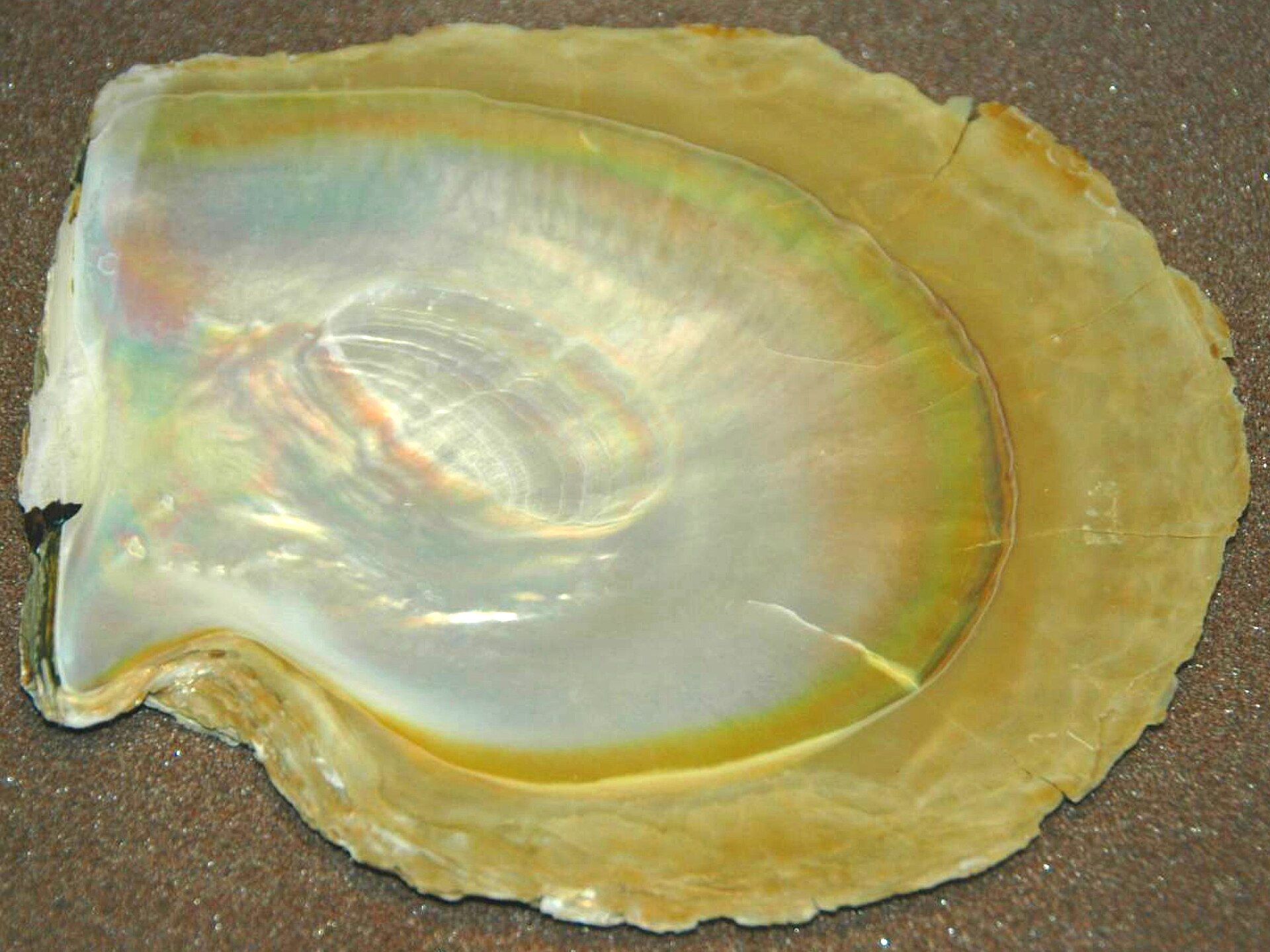

Before culturing, pearling fleets dived for this oyster’s large natural pearls and for its mother-of-pearl.1 CIBJO defines a South Sea cultured pearl by the oyster, as one grown in P. maxima.1 US guidance defines it by place instead: a South Sea pearl must come from a saltwater mollusk of the Pacific Ocean South Sea Islands, Australia or Southeast Asia.14
Where South Sea pearls are farmed#
South Sea pearls are cultured mainly in Australia, Indonesia, the Philippines and Myanmar.1 CIBJO’s 2025 guide describes the main producing regions this way:6
- Australia: mostly wild, silver-lipped oysters caught by divers; pearls typically 11 to 16 mm; one pearl per oyster every 2 to 3 years; about 800,000 pearls a year, with a retail value of about US$300 million.6
- The Philippines: hatchery-bred, mostly gold-lipped oysters; pearls typically 9 to 16 mm, mostly champagne to gold; one pearl every 2 to 3 years; about 1 million pearls a year, worth about US$230 million at retail.6
- Indonesia, Myanmar and Vietnam: hatchery-bred silver- and gold-lipped oysters; pearls typically 8 to 13 mm, mostly cream to gold; one pearl every 1 to 2 years; about 3 million pearls a year, worth about US$230 million at retail.6
Wild oysters make up about 70% of Australia’s production, and some oysters are now bred in hatcheries to supplement and protect the wild stocks.6 In Western Australia, the regulator sets a yearly quota across three fishing zones for 14 licence holders, from 500,000 oysters to 1.5 million in a good year, and places observers on pearling vessels.11
How South Sea pearls are grown#
In Western Australia, divers hand-pick wild oysters from the seabed in the Pilbara and Kimberley regions, with the main grounds near Broome, and the oysters are often seeded on board the pearling boats. Seeding means surgically inserting a shell bead, together with a piece of mantle from another oyster, into the oyster’s gonad.11
The seeded oysters go back to the seabed in net panels, which are turned regularly for three months to help the pearls grow round. They then move to sheltered farm waters on floating lines, where crews regularly clean off parasites, because a stressed oyster can produce a blemished pearl.11
Nacre first forms on the bead about 45 days after the operation, and it is secreted fastest in water of 25–30 °C.12 GIA says P. maxima generally needs at least two years to grow its pearls,2 and Western Australia’s fisheries department says it takes up to two years for the pearls to reach a desirable size and quality.11 Across these sources, the dataset gives a growing time of 1–3 years (two to three years in Australia and the Philippines)6.
Good oysters can be seeded several times, each time with a larger bead, so each pearl is larger than the one before.11 One oyster can produce up to four pearls this way.12 In 1954, a joint venture began culturing pearls in Pinctada maxima at what is now Kuri Bay, Western Australia, where a method using larger beads let the farm harvest after only 18 months.15
South Sea sizes, shapes and colors#
South Sea cultured pearls are typically 9–16 mm, within a range of 8–18 mm6, and pearls over 20 mm are rare.6 GIA’s journal describes them as much larger than Akoya, routinely over 10 mm in diameter.15
CIBJO lists their shapes as round, oval, button, drop, circled and baroque6, and GIA says they are most often round, though any shape occurs.4
Their colors are white, silver, cream, champagne and golden6, with overtones of pink, blue and green.6 GIA notes that yellow ones are often called “golden” in the trade.4
Quality factors for South Sea pearls#
South Sea cultured pearls are judged on GIA’s seven value factors.16 Their nacre is their strength: it is the thickest of any bead-cultured pearl,2 typically between 1.5 and 3.0 mm.10 In one X-ray image GIA published, an 11.15 mm South Sea pearl had about 1.92 mm of nacre, against 0.34 mm on a 6.85 mm Akoya.17
GIA notes that South Sea pearls often have a satiny luster.18 CIBJO says fine-quality Australian South Sea cultured pearls need no treatment, while lower qualities are given maeshori, a luster treatment.6 A GIA study of low-quality pearls found that processing to improve their surfaces could remove all the nacre, leaving only a coated bead.10
What affects the price of South Sea pearls#
GIA’s journal describes South Sea pearls as significantly more costly than Akoya.15 GIA attributes their value to their size, their thick nacre and the limited conditions they need to grow.3 Within South Sea pearls, the usual value factors set the price, and when other factors are equal, larger pearls are rarer and more valuable.18
Identification, treatments and imitations#
X-ray imaging shows the bead in a South Sea pearl and lets labs measure its nacre.17 It also helps separate bead-cultured, non-bead cultured and natural pearls from this oyster.2
Golden color can be natural, or produced by heat or dye. Labs separate natural from treated golden pearls with UV-visible spectroscopy, fluorescence and photoluminescence.8 9 19 South Sea pearls are generally not treated in their countries of origin beyond washing and polishing, though some Japanese pearl companies treat them.12
Pearls without a bead also come from this oyster. These non-bead cultured pearls, sold as keshi, can have internal structures much like those of natural pearls; the page keshi pearls explains them.20
Caring for South Sea pearls#
South Sea cultured pearls need the same care as other pearls. Put them on after perfume and cosmetics,13 wipe them with a soft cloth dampened in clean water after wearing, and keep them away from acids, solvents, heat and ultrasonic cleaners.1 The care section has the full routine.
Questions people ask#
Is the color of golden South Sea pearls natural?
It can be. Golden South Sea cultured pearls come naturally from the gold-lipped Pinctada maxima oyster, but golden color can also be produced by heat or dye. Labs separate natural from treated color with UV-visible spectroscopy, fluorescence and photoluminescence.2 8 9 19
Where do South Sea pearls come from?
Mainly Australia, Indonesia, the Philippines and Myanmar. Australia is the largest producer of white South Sea cultured pearls, while Indonesia, Myanmar and the Philippines are major producers of golden ones.1 2
How big are South Sea pearls?
Typically 9 to 16 mm, and occasionally over 20 mm. GIA's journal describes them as much larger than Akoya, routinely over 10 mm in diameter.6 15
How long do South Sea pearls take to grow?
Sources differ. GIA says Pinctada maxima generally needs at least two years. CIBJO gives two to three years in Australia and the Philippines, and one to two years in Indonesia and nearby countries. Western Australia's fisheries department says up to two years.2 6 11
References#
- CIBJO, The World Jewellery Confederation, Pearl Commission (2026). The CIBJO Pearl Book (Pearl Blue Book) 2026. Source · Archived copy (accessed 2026-10-25)
- Artitaya Homkrajae, Nanthaporn Nilpetploy, Areeya Manustrong, Nicholas Sturman, Kwanreun Lawanwong and Promlikit Kessrapong (2021). Internal Structures of Known Pinctada maxima Pearls: Cultured Pearls from Operated Marine Mollusks. Source · DOI 10.5741/GEMS.57.3.186 · Archived copy (accessed 2026-10-25)
- Gemological Institute of America (GIA), Gem Encyclopedia. Pearl Description. Source · Archived copy (accessed 2026-10-25)
- Gemological Institute of America (GIA), FAQ. What are the main types of cultured pearls and what are their distinctive characteristics?. Source · Archived copy (accessed 2026-10-25)
- Fisheries Agency of Japan (水産庁) (2026). 真珠養殖をめぐる情勢について (On the situation of pearl culture). Source · Archived copy (accessed 2026-10-25)
- CIBJO Pearl Commission (2025). CIBJO Guides Describing and Classifying Natural and Cultured Pearls, the Producing Molluscs & Responsible Pearling. Source · Archived copy (accessed 2026-10-25)
- Smithsonian National Museum of Natural History. South Sea Pearl Ring (NMNH G10639). Source · Archived copy (accessed 2026-10-25)
- Shane Elen (2001). Spectral Reflectance and Fluorescence Characteristics of Natural-Color and Heat-Treated "Golden" South Sea Cultured Pearls. Source · DOI 10.5741/GEMS.37.2.114 · Archived copy (accessed 2026-10-25)
- Chunhui Zhou, Artitaya Homkrajae, Joyce Wing Yan Ho, Akira Hyatt and Nicholas Sturman (2012). Update on the Identification of Dye Treatment in Yellow or "Golden" Cultured Pearls. Source · DOI 10.5741/GEMS.48.4.284 · Archived copy (accessed 2026-10-25)
- Nanthaporn Nilpetploy, Kwanreun Lawanwong, Promlikit Kessrapong, Areeya Manustrong and Nicholas Sturman (2021). A study on improving the surface appearance of low-quality Pinctada maxima bead cultured pearls. Source · Archived copy (accessed 2026-10-25)
- Department of Primary Industries and Regional Development, Government of Western Australia. Pearl oyster fishery in Western Australia. Source · Archived copy (accessed 2026-10-25)
- Changbo Zhu, Paul C. Southgate and Ting Li (2019). Production of Pearls. Source · DOI 10.1007/978-3-319-96776-9_5 · Archived copy (accessed 2026-10-25)
- Gemological Institute of America (GIA), Gem Encyclopedia. Pearl Buyer's Guide. Source · Archived copy (accessed 2026-10-25)
- U.S. Federal Trade Commission (Electronic Code of Federal Regulations). 16 CFR Part 23, Guides for the Jewelry, Precious Metals, and Pewter Industries. Source · Archived copy (accessed 2026-10-25)
- Russell Shor (2007). From Single Source to Global Free Market: The Transformation of the Cultured Pearl Industry. Source · DOI 10.5741/GEMS.43.3.200 · Archived copy (accessed 2026-10-25)
- Gemological Institute of America (GIA), Analysis & Grading. How GIA Identifies and Classifies Pearls. Source · Archived copy (accessed 2026-10-25)
- Chunhui Zhou and W. Henry Towbin (2024). Applications of X-Ray Radiography and X-Ray Computed Microtomography in Gemology. Source · DOI 10.5741/GEMS.60.4.582 · Archived copy (accessed 2026-10-25)
- Gemological Institute of America (GIA), Gem Encyclopedia. Pearl Quality Factors. Source · Archived copy (accessed 2026-10-25)
- Shane Elen (2002). Update on the Identification of Treated "Golden" South Sea Cultured Pearls. Source · DOI 10.5741/GEMS.38.2.156 · Archived copy (accessed 2026-10-25)
- Nishka Vaz, Abeer Al-Alawi and Anukul Belanke (2026). Diverse Range of Organic-Rich Cores in South Sea Non-Bead Cultured "Keshi" Pearls. Source · DOI 10.5741/GEMS.62.1.26 · Archived copy (accessed 2026-10-25)
- Written by
- Learn About Pearls editors
- Fact-checked
- Learn About Pearls editors,
- Reviewed by
- Simon,
- First published
- Publisher
- Unique Pearl, a pearl jeweler
Revision history
- : First published. First published
How to cite this page
- APA
- Learn About Pearls editors. (2026). South Sea Pearls: Origin, Colors, Sizes and Value. Learn About Pearls. https://learnaboutpearls.com/types/south-sea-pearls/
- MLA
- “South Sea Pearls: Origin, Colors, Sizes and Value.” Learn About Pearls, Unique Pearl, November 4, 2026, learnaboutpearls.com/types/south-sea-pearls/.
- Chicago
- Learn About Pearls editors. “South Sea Pearls: Origin, Colors, Sizes and Value.” Learn About Pearls. Unique Pearl. Last modified November 4, 2026. https://learnaboutpearls.com/types/south-sea-pearls/.
- BibTeX
@misc{lap-types-south-sea-pearls, title = {South Sea Pearls: Origin, Colors, Sizes and Value}, author = {{Learn About Pearls editors}}, year = {2026}, howpublished = {\url{https://learnaboutpearls.com/types/south-sea-pearls/}}, note = {Learn About Pearls, published by Unique Pearl}}
Quoting with attribution and a link is welcome. See how to cite and reuse.