How Do Pearls Form?
Short answerA pearl forms when cells from a mollusk's mantle, the tissue that builds its shell, end up inside its body and form a closed pocket called a pearl sac. The sac lays down layer after layer of nacre, the material that lines the shell. Natural pearls start by accident, after an injury, a parasite or a lodged particle. Cultured pearls start when a technician inserts a piece of mantle tissue, usually with a shell bead.
- To start a saltwater cultured pearl, a technician inserts a piece of donor mantle tissue about 3 × 3 mm, together with a polished shell bead, into the oyster's gonad.1
- The beads are usually cut from freshwater mussel shell and range from about 2 to 14 mm, depending on the oyster species.2
- In black-lipped pearl oysters, the graft grows into a pearl sac around the bead within 14 days, and the first nacre appears about 32 days after grafting.1
- Saltwater bead-cultured pearls are generally harvested after another 1 to 2 years in the water, and many Akoya within a year. Freshwater pearls usually take 1 to 5 years.1 3
- A freshwater mussel can take up to 20 grafts in each of its two mantle lobes, and 30 to 40 pearls at a time is usual.1 3
- Natural pearls are rare. Hundreds of wild pearl oysters or mussels must be opened to find even one.1
- Nacre is built from microscopic platelets of aragonite, a form of calcium carbonate, bound together by an organic material called conchiolin.2
On this page
Every pearl, natural or cultured, is grown by a living mollusk. The sections below follow a pearl from the first cells to the finished layers, and show how pearl farms copy the process.
What a pearl is made of#
A pearl is made of the same material as the lining of the shell it grew in. The mantle, the tissue that builds the shell, also makes pearls, and pearls have the same composition as shell nacre, with calcium carbonate as the main ingredient.1
Nacre forms in layers of microscopic aragonite platelets, bound together by an organic material called conchiolin. That layered structure is what gives a pearl its orient and overtone.2
Not every pearl has nacre. Conch, clam and scallop pearls, for example, are natural pearls without a nacreous surface.2
Natural pearl
- Starts by accident, with no human help
- Nacre layers reach a tiny center
Bead-cultured pearl
- A shell bead and a graft go into the gonad
- Nacre covers the bead
Non-beaded cultured pearl
- Mantle tissue alone, no bead
- Often a small hollow or organic center
Text version of this diagram
The diagram shows three pearls cut in half. The natural pearl has many thin rings of nacre that reach all the way to a tiny center, with a dashed ring around the outside for the pearl sac. The bead-cultured pearl has a large shell bead in the middle and only a few rings of nacre around it, inside the same kind of sac. The pearl grown from mantle tissue alone has rings of nacre around a small, irregular hollow at its center, again inside a sac.
How a natural pearl forms#
A natural pearl forms when cells from the outer layer of the mantle end up inside the mollusk’s body, where they keep making nacre. A predator, a parasite or a particle lodged in the tissue can move the cells there.1
John Pfeiffer, curator of bivalves at the Smithsonian’s National Museum of Natural History, describes it as shell-making tissue in the wrong place. The misplaced tissue forms a pocket, the pearl sac, where a pearl can grow.4
Inside the sac, the cells coat whatever lies at the center. In pearl oysters they lay down nacre, and in other mollusks a non-nacreous form of calcium carbonate, so the pearl grows layer by layer.2 GIA says natural pearls usually form around a microscopic irritant, and always without any human help.5
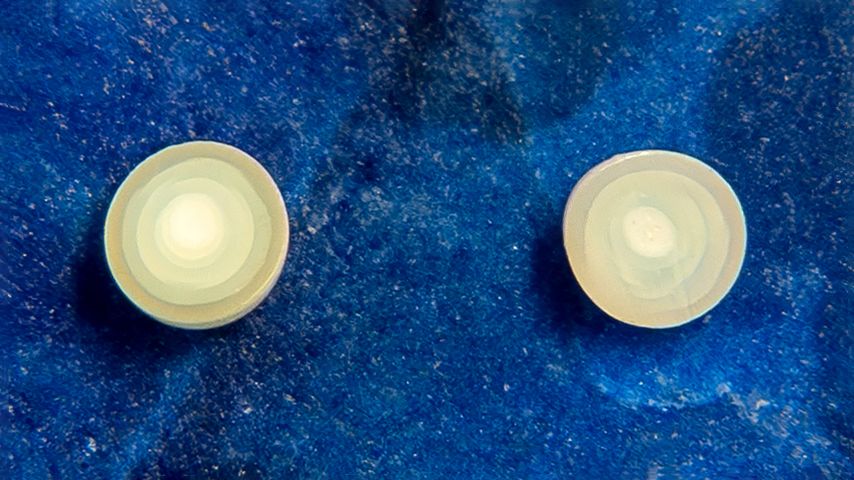

Natural pearls are rare. Hundreds of wild pearl oysters or mussels must be opened to find even one, and perfectly round natural pearls are extremely rare.1
How a cultured pearl is grown#
A cultured pearl grows the same way as a natural one, except that people start it. For a saltwater pearl, a technician cuts a small piece of mantle tissue, the graft, from a donor oyster. The graft, about 3 × 3 mm, goes into the gonad of a host oyster together with a polished shell bead.1 The tissue then grows into a sac around the bead and lays nacre onto it.5
The beads are usually cut and polished from the shell of a freshwater mussel, and they range from about 2 to 14 mm, depending on the oyster species.2 In black-lipped pearl oysters, the sac covers the bead within 14 days, and the first nacre appears about 32 days after grafting.1
After the operation, saltwater oysters generally stay in the water for 1 to 2 more years before harvest.1 Akoya pearls are often ready sooner, and many are harvested within a year.3 Each Akoya or South Sea oyster grows one pearl at a time. After a harvest, a South Sea oyster can be given a new, larger bead, and one oyster can produce up to four pearls in all.1
Farms try to harvest when the water is cold. Nacre then forms more slowly, so the pearl’s surface comes out smoother and more lustrous.1
Pearls can also form on a farm by accident. When an oyster rejects its bead, or a scrap of tissue forms its own sac, it can grow a keshi, a cultured pearl with no bead.2 Labs call these non-bead cultured pearls.6
How freshwater pearls grow without a bead#
Freshwater cultured pearls usually grow from mantle tissue alone. A freshwater pearl doesn’t need a bead to form.1 Almost all freshwater pearls are grown this way.7
The grafts go into the mussel’s mantle, up to 20 in each of its two mantle lobes.1 A mussel usually produces 30 to 40 pearls at a time.3 Freshwater culture usually takes 1 to 5 years, depending on the method and the species of mussel.1
Some freshwater pearls are now grown with a shell bead, the same method used for Akoya. Pearls grown from tissue alone often have irregular shapes, while these bead-cultured freshwater pearls are often near-round to round.8
Why the layers make a pearl shine#
A pearl’s luster comes from light reflecting off its surface and off the concentric layers of nacre inside it.9 The same layered structure produces orient, a soft rainbow shimmer, and overtones, secondary colors over the pearl’s bodycolor.2
In a bead-cultured pearl, the nacre over the bead is what you see. Nacre thickness is closely tied to how long the pearl was grown, and it can affect the pearl’s color, luster and durability.2 GIA checks nacre thickness to make sure a cultured pearl is durable as well as beautiful.9
How long each type of pearl takes to grow#
Growing times differ by type, because each mollusk and farming method is different. The table gives each type’s range from the Learn About Pearls dataset, and the page how long pearls take to grow explains the timings.
| Type | Growing time |
|---|---|
| Akoya cultured pearl | 6–36 months (typically 10 to 14 months)7 |
| Freshwater cultured pearl | 1–5 years (depending on the culture method and mussel)1 |
| South Sea cultured pearl | 1–3 years (two to three years in Australia and the Philippines)3 |
| Tahitian cultured pearl | 18–24 months10 |
How labs tell natural pearls from cultured ones#
Labs tell natural, bead-cultured and non-bead cultured pearls apart mainly with X-ray imaging. A bead-cultured pearl usually shows a clear line where the nacre meets the shell bead, and labs can measure the nacre’s thickness from the image.11
Pearls grown without a bead are harder to identify. They show organic-rich centers, voids or fine lines, and because some of these also occur in natural pearls, a few results are inconclusive.6
Questions people ask#
Do pearls start from a grain of sand?
A lodged particle can be the trigger, but the pearl itself comes from shell-making tissue that ends up in the wrong place and forms a pearl sac. That can also follow an injury or a parasite. GIA says natural pearls usually form around a microscopic irritant.1 4 5
How long does it take a pearl to form?
Saltwater cultured pearls are generally harvested 1 to 2 years after the bead goes in, and many Akoya within a year. Freshwater cultured pearls usually take 1 to 5 years, depending on the method and the mussel.1 3
Can any mollusk make a pearl?
Almost all mollusks can make pearl-like objects, which scientists call calcareous concretions. The pearls valued as gems come from mollusks that make nacre, mainly marine pearl oysters and freshwater pearl mussels. Some natural pearls have no nacre at all, such as conch, clam and scallop pearls.1 2
References#
- Changbo Zhu, Paul C. Southgate and Ting Li (2019). Production of Pearls. Source · DOI 10.1007/978-3-319-96776-9_5 · Archived copy (accessed 2026-10-25)
- CIBJO, The World Jewellery Confederation, Pearl Commission (2026). The CIBJO Pearl Book (Pearl Blue Book) 2026. Source · Archived copy (accessed 2026-10-25)
- CIBJO Pearl Commission (2025). CIBJO Guides Describing and Classifying Natural and Cultured Pearls, the Producing Molluscs & Responsible Pearling. Source · Archived copy (accessed 2026-10-25)
- Emma Denes (2025). How Oysters Create the Ocean's Gems. Source · Archived copy (accessed 2026-10-25)
- Gemological Institute of America (GIA), Gem Encyclopedia. Pearl Description. Source · Archived copy (accessed 2026-10-25)
- Artitaya Homkrajae, Nanthaporn Nilpetploy, Areeya Manustrong, Nicholas Sturman, Kwanreun Lawanwong and Promlikit Kessrapong (2021). Internal Structures of Known Pinctada maxima Pearls: Cultured Pearls from Operated Marine Mollusks. Source · DOI 10.5741/GEMS.57.3.186 · Archived copy (accessed 2026-10-25)
- Fisheries Agency of Japan (水産庁) (2026). 真珠養殖をめぐる情勢について (On the situation of pearl culture). Source · Archived copy (accessed 2026-10-25)
- Phoebe Shang (2026). Freshwater Akoyas – A Trending Misnomer for Certain Freshwater Pearls. Source · Archived copy (accessed 2026-10-25)
- Gemological Institute of America (GIA), Gem Encyclopedia. Pearl. Source · Archived copy (accessed 2026-10-25)
- Oïhana Latchere and others (2018). Influence of water temperature and food on the last stages of cultured pearl mineralization from the black-lip pearl oyster Pinctada margaritifera. Source · DOI 10.1371/journal.pone.0193863 · Archived copy (accessed 2026-10-25)
- Chunhui Zhou and W. Henry Towbin (2024). Applications of X-Ray Radiography and X-Ray Computed Microtomography in Gemology. Source · DOI 10.5741/GEMS.60.4.582 · Archived copy (accessed 2026-10-25)
- Gemological Institute of America (GIA), Gem Encyclopedia. Pearl Quality Factors. Source · Archived copy (accessed 2026-10-25)
- U.S. Federal Trade Commission (Electronic Code of Federal Regulations). 16 CFR Part 23, Guides for the Jewelry, Precious Metals, and Pewter Industries. Source · Archived copy (accessed 2026-10-25)
- Written by
- Learn About Pearls editors
- Fact-checked
- Learn About Pearls editors,
- Reviewed by
- Simon,
- First published
- Publisher
- Unique Pearl, a pearl jeweler
Revision history
- : First published. First published
How to cite this page
- APA
- Learn About Pearls editors. (2026). How Do Pearls Form? Learn About Pearls. https://learnaboutpearls.com/basics/how-pearls-form/
- MLA
- “How Do Pearls Form?” Learn About Pearls, Unique Pearl, November 4, 2026, learnaboutpearls.com/basics/how-pearls-form/.
- Chicago
- Learn About Pearls editors. “How Do Pearls Form?” Learn About Pearls. Unique Pearl. Last modified November 4, 2026. https://learnaboutpearls.com/basics/how-pearls-form/.
- BibTeX
@misc{lap-basics-how-pearls-form, title = {How Do Pearls Form?}, author = {{Learn About Pearls editors}}, year = {2026}, howpublished = {\url{https://learnaboutpearls.com/basics/how-pearls-form/}}, note = {Learn About Pearls, published by Unique Pearl}}
Quoting with attribution and a link is welcome. See how to cite and reuse.