Freshwater Pearls: Origin, Sizes, Quality and Value
Short answerFreshwater pearls are cultured pearls grown in freshwater mussels, mainly the triangle shell mussel, in lakes and ponds in China. Most grow from pieces of mantle tissue alone, with no bead, many to a mussel, over one to five years. They come in a wide range of shapes, sizes and natural colors, from white and pink to peach and lavender, and GIA calls them the most affordable pearl type.
| Mollusk | Hyriopsis cumingii (triangle shell mussel)1 2 3 4 |
|---|---|
| Water | freshwater1 5 |
| Natural or cultured | cultured1 |
| Main producing regions | China2 5 6 |
| Typical size | 3–15 mm2 7 |
| Size range | 3–25 mm2 7 |
| Shapes | round, near-round, oval, coin and baroque2 7 8 |
| Natural colors | white, cream, pink, peach, orange, lavender and purple1 2 3 |
| Growing time | 1–5 years (depending on the culture method and mussel)4 8 9 |
| Nacre | Most are grown from mantle tissue alone, with no bead. Bead-cultured freshwater pearls, such as Edison pearls, have a shell bead at the center.6 7 10 |
| Relative price | The most affordable pearl type (GIA)3 |
- China grows almost all of the world's freshwater cultured pearls. CIBJO estimates its output at about 1,000 to 1,500 tonnes, or 800 million to 1 billion pearls, a year.2 9
- A mussel can take up to 20 grafts in each of its two mantle lobes, and 30 to 40 pearls at a time is usual.2 9
- Freshwater culture usually takes 1 to 5 years, depending on the method and the mussel.9
- Non-beaded freshwater pearls are typically 3 to 15 mm and bead-cultured ones usually 5 to 15 mm, with extremes from 3 to 25 mm.2
- Freshwater pearls contain more manganese and barium and less strontium than saltwater pearls, a difference labs use to tell them apart.11
- Bleaching is common, and optical brightening is routinely applied to untreated, naturally colored freshwater cultured pearls after harvest.2 10
- Japan imported only 600 grams of Chinese freshwater cultured pearls in 1971, and over 49 tons in 1984.8
On this page
Freshwater cultured pearls are cultured pearls grown in freshwater mussels. They are the most commonly produced pearls, and among the most popular, for their range of sizes, shapes and colors and their lower prices.5
Where freshwater pearls come from#
Freshwater pearls grow in mussels, not oysters. In China most come from the triangle shell mussel, Hyriopsis cumingii, with Hyriopsis schlegelii and Cristaria plicata also used.2 GIA describes pearls from H. cumingii and its hybrids,3 while CIBJO’s 2025 guide reports that hybrid mussels are no longer used in China.2
Japan once had its own freshwater pearl industry. Hyriopsis schlegelii was used in Lake Biwa and Lake Kasumigaura from the early 1900s until before the 1990s.2 Japan’s freshwater pearl output peaked at 6.3 tons in 1980 and fell to 214 kg by 1998, after water contamination and high mussel mortality.8 Chinese researchers later imported H. schlegelii from Japan and crossbred it with the native H. cumingii.4
Chinese freshwater cultured pearls first appeared on the market in the late 1960s and early 1970s.8 Japan imported only 600 grams of them in 1971, but over 49 tons in 1984, mostly for export to other countries.8
Where freshwater pearls are farmed#
China is the leading source of freshwater cultured pearls.5 Most are grown in Zhejiang, Hubei, Hunan, Anhui, Jiangsu and Jiangxi provinces, in lakes and ponds.2
The volume is enormous. From 2005 to 2014, China produced an average of 3,540 tonnes of pearls a year, 99.5% of them freshwater, and over 98% of the world’s cultured pearl output by weight.9 Because freshwater pearls sell for much less than saltwater pearls, that output made up only about 5% of the world’s pearl value.9 CIBJO’s current estimate is 1,000 to 1,500 tonnes a year, or 800 million to 1 billion pearls, with a retail value of about US$3 billion in 2024.2
Farming at that scale has costs. CIBJO reports that intensive farming, which adds phosphates to the water to feed the mussels, is causing environmental problems, including severe pollution of water tables in some areas of China.2
How freshwater pearls are grown#
Most freshwater pearls are grown without a bead. A technician implants pieces of mantle tissue into the mussel’s mantle, up to 20 in each of its two mantle lobes,9 and nacre forms around each piece.5 Almost all freshwater pearls are grown this way.6
Freshwater mussels grow faster than pearl oysters and are ready for grafting within a year.9 A mussel usually produces 30 to 40 non-beaded pearls at a time, but only one or two when a large bead is used.2 Culture usually takes 1 to 5 years, depending on the method and the mussel,9 and the dataset gives a growing time of 1–5 years (depending on the culture method and mussel)9.
Time in the water trades against size. In 2001, GIA’s journal described growers who grafted mussels about two and a half years old and harvested two to three years later, and others who grafted younger mussels and grew the pearls for four to six years to get larger pearls.8
Some freshwater pearls are now grown around a shell bead, the method used for Akoya. These are often near-round to round, bright white and very lustrous.3 Trade names for bead-cultured freshwater pearls include Coin, Fireball, Edison, Ming and Soufflé; a soufflé pearl’s core is removed after drilling, which leaves it hollow.2
Freshwater sizes, shapes and colors#
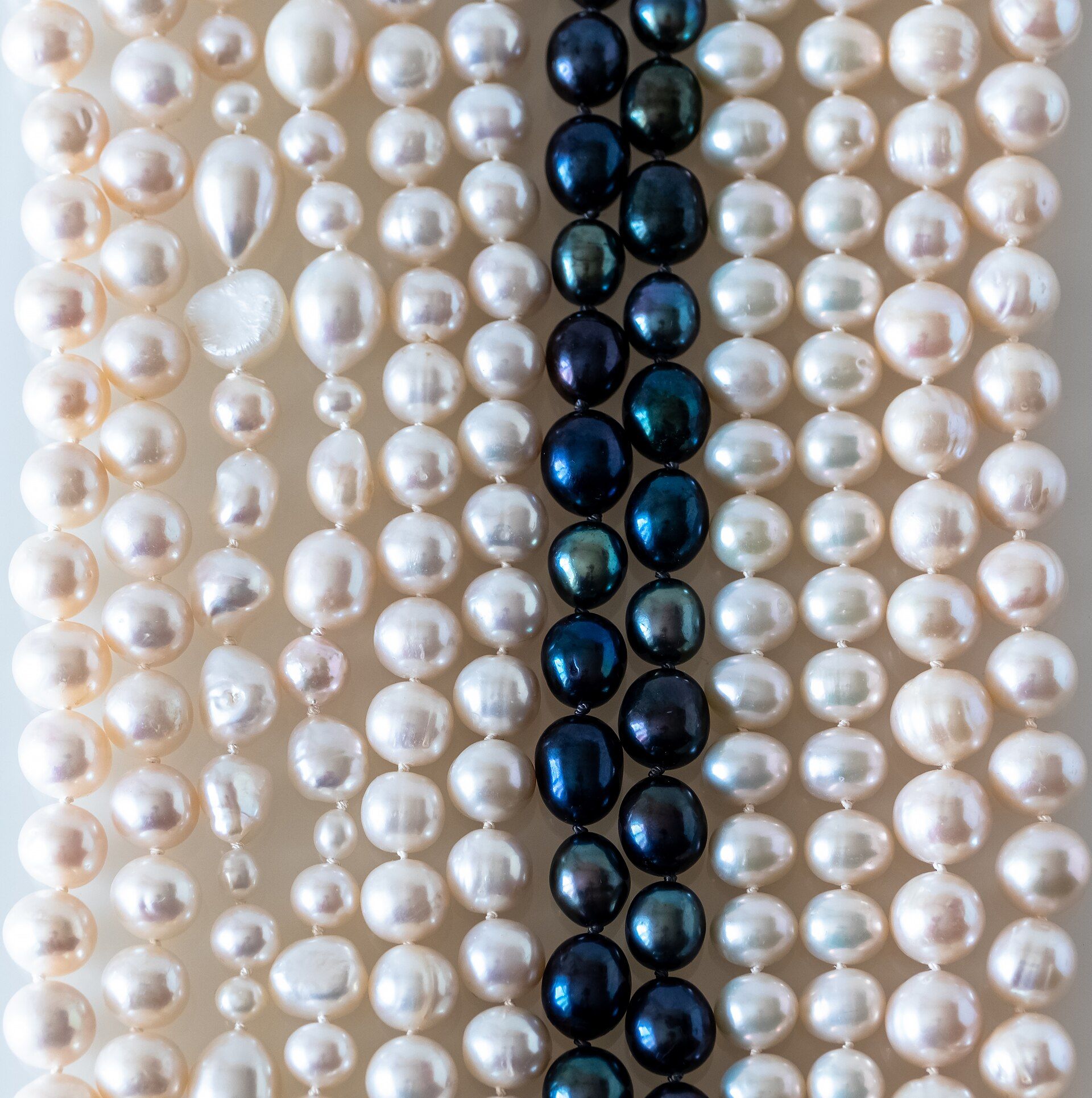
Freshwater cultured pearls are typically 3–15 mm, within a range of 3–25 mm2. GIA notes that the smaller pearls are usually non-bead cultured, while the larger ones are often bead-cultured.7
CIBJO lists freshwater shapes as round, near-round, oval, coin and baroque2. In 2001, GIA described Chinese freshwater pearls in shapes from extreme baroque to perfect round, a big change from the bulbous oval “potato” pearls common in earlier years.8
Freshwater pearls come in white, cream, pink, peach, orange, lavender and purple2. CIBJO adds that darker natural colors often show a metallic luster, and that yellow and green are rare.2

Quality factors for freshwater pearls#
Freshwater cultured pearls are judged on the same factors as saltwater pearls. CIBJO’s guide, following a 2023 standard, lists six: color, size, shape, luster, surface condition and nacre thickness, with matching added for jewelry with several pearls.2
Shape weighs heavily. Round is the most difficult shape to culture and the rarest cultured pearl shape, and when other factors are equal it is generally worth the most.12 A GIA report also states whether pearls grew in freshwater or saltwater.3
What affects the price of freshwater pearls#
GIA calls freshwater cultured pearls the most affordable pearl type, and says Akoya cost more than freshwater pearls of similar size and quality, in part because they are rarer and cost more to culture.3 Freshwater production is so large that lustrous examples are affordable, in part because each mussel produces dozens of pearls.13
Within freshwater pearls, the usual factors set the price. When other factors are equal, larger pearls are rarer and more valuable.12
Identification, treatments and imitations#
Labs separate freshwater from saltwater pearls by chemistry. Freshwater pearls contain more manganese and barium and less strontium, and they glow more strongly under X-rays, because X-ray luminescence brightens with manganese.11 14
Bead-cultured freshwater pearls can look like Akoya and are sometimes sold as “freshwater Akoya”, a name GIA calls incorrect. A GIA report states the environment a pearl grew in.3
Treatments are common. CIBJO says it is common for Chinese freshwater pearls to be bleached and otherwise treated.2 GIA reports that optical brightening is routinely applied to untreated, naturally colored freshwater cultured pearls after harvest, and that the most common color treatments are dyeing and irradiation.10
Imitations are a separate matter. In the United States an imitation pearl must be called “imitation”, “artificial” or “simulated” whenever the word “pearl” is used.15
Caring for freshwater pearls#
Freshwater cultured pearls need the same care as other pearls. Put them on after perfume and cosmetics,13 wipe them with a soft cloth dampened in clean water after wearing, and keep them away from acids, solvents, heat and ultrasonic cleaners. Some color-treated pearls can fade or revert to their original color under strong light.1 The care section has the full routine.
Questions people ask#
Are freshwater pearls real pearls?
Freshwater pearls are cultured pearls, grown by living mussels that coat implanted pieces of tissue, or sometimes a bead, with nacre. They are not imitations. In the United States and under CIBJO's standards they must be described as cultured, and CIBJO requires the full name "freshwater cultured pearl".1 5 15
Do freshwater pearls have a bead inside?
Most don't. Almost all freshwater pearls are grown from mantle tissue alone. Some, sold under trade names such as Edison, Ming and Fireball, are grown around a shell bead and are often near-round to round.2 3 6
Why are freshwater pearls cheaper than Akoya pearls?
GIA says Akoya are rarer and cost more to culture. Freshwater production is also enormous, because each mussel produces dozens of pearls, while an Akoya oyster grows one at a time.3 9 13
What colors do freshwater pearls come in?
Natural colors include white, cream, pink, orange, dark purple, violet and mauve, with yellow and green rare. Darker natural colors often have a metallic luster.2
What are "freshwater Akoya" pearls?
They are bead-cultured freshwater pearls, not Akoya pearls, which come only from the saltwater Akoya oyster. GIA calls names such as "freshwater Akoya", "Chinese Akoya" and "baby Akoya" misleading.3
References#
- CIBJO, The World Jewellery Confederation, Pearl Commission (2026). The CIBJO Pearl Book (Pearl Blue Book) 2026. Source · Archived copy (accessed 2026-10-25)
- CIBJO Pearl Commission (2025). CIBJO Guides Describing and Classifying Natural and Cultured Pearls, the Producing Molluscs & Responsible Pearling. Source · Archived copy (accessed 2026-10-25)
- Phoebe Shang (2026). Freshwater Akoyas – A Trending Misnomer for Certain Freshwater Pearls. Source · Archived copy (accessed 2026-10-25)
- Doug Fiske and Jeremy Shepherd (2007). Continuity and Change in Chinese Freshwater Pearl Culture. Source · DOI 10.5741/GEMS.43.2.138 · Archived copy (accessed 2026-10-25)
- Gemological Institute of America (GIA), Gem Encyclopedia. Pearl Description. Source · Archived copy (accessed 2026-10-25)
- Fisheries Agency of Japan (水産庁) (2026). 真珠養殖をめぐる情勢について (On the situation of pearl culture). Source · Archived copy (accessed 2026-10-25)
- Gemological Institute of America (GIA), FAQ. What are the main types of cultured pearls and what are their distinctive characteristics?. Source · Archived copy (accessed 2026-10-25)
- Shigeru Akamatsu, Li Tajima Zansheng, Thomas M. Moses and Kenneth Scarratt (2001). The Current Status of Chinese Freshwater Cultured Pearls. Source · DOI 10.5741/GEMS.37.2.96 · Archived copy (accessed 2026-10-25)
- Changbo Zhu, Paul C. Southgate and Ting Li (2019). Production of Pearls. Source · DOI 10.1007/978-3-319-96776-9_5 · Archived copy (accessed 2026-10-25)
- Chunhui Zhou and others (2021). Detection of Color Treatment and Optical Brightening in Chinese Freshwater "Edison" Pearls. Source · DOI 10.5741/GEMS.57.2.124 · Archived copy (accessed 2026-10-25)
- Stefanos Karampelas and others (2019). Chemical Characteristics of Freshwater and Saltwater Natural and Cultured Pearls from Different Bivalves. Source · DOI 10.3390/min9060357 · Archived copy (accessed 2026-10-25)
- Gemological Institute of America (GIA), Gem Encyclopedia. Pearl Quality Factors. Source · Archived copy (accessed 2026-10-25)
- Gemological Institute of America (GIA), Gem Encyclopedia. Pearl Buyer's Guide. Source · Archived copy (accessed 2026-10-25)
- H. A. Hänni (2006). A short review of the use of "keshi" as a term to describe pearls. Source · DOI 10.15506/JoG.2006.30.1.51 · Archived copy (accessed 2026-10-25)
- U.S. Federal Trade Commission (Electronic Code of Federal Regulations). 16 CFR Part 23, Guides for the Jewelry, Precious Metals, and Pewter Industries. Source · Archived copy (accessed 2026-10-25)
- Written by
- Learn About Pearls editors
- Fact-checked
- Learn About Pearls editors,
- Reviewed by
- Simon,
- First published
- Publisher
- Unique Pearl, a pearl jeweler
Revision history
- : First published. First published
How to cite this page
- APA
- Learn About Pearls editors. (2026). Freshwater Pearls: Origin, Sizes, Quality and Value. Learn About Pearls. https://learnaboutpearls.com/types/freshwater-pearls/
- MLA
- “Freshwater Pearls: Origin, Sizes, Quality and Value.” Learn About Pearls, Unique Pearl, November 4, 2026, learnaboutpearls.com/types/freshwater-pearls/.
- Chicago
- Learn About Pearls editors. “Freshwater Pearls: Origin, Sizes, Quality and Value.” Learn About Pearls. Unique Pearl. Last modified November 4, 2026. https://learnaboutpearls.com/types/freshwater-pearls/.
- BibTeX
@misc{lap-types-freshwater-pearls, title = {Freshwater Pearls: Origin, Sizes, Quality and Value}, author = {{Learn About Pearls editors}}, year = {2026}, howpublished = {\url{https://learnaboutpearls.com/types/freshwater-pearls/}}, note = {Learn About Pearls, published by Unique Pearl}}
Quoting with attribution and a link is welcome. See how to cite and reuse.