What Is Nacre, or Mother-of-Pearl?
Short answerNacre is the material that lines the inside of some mollusk shells and makes up most of the pearls valued as gems. It is built from microscopic platelets of aragonite, a form of calcium carbonate, bound together by an organic protein called conchiolin, in thin, regular layers that give pearls their luster and iridescence. Mother-of-pearl is nacre lining a shell; a pearl is nacre laid down in layers inside the mollusk's body.
- Nacre is made of layers of microscopic aragonite platelets, bound together by a fine network of conchiolin, an organic protein.1
- The nacre of Tahitian cultured pearls is about 92% aragonite and 6% conchiolin, with the rest mineral salts and water.2
- Mother-of-pearl is the smooth, hard, iridescent lining of the inner shell, which scientists call nacre.1
- Natural pearls usually have the same color, composition and general quality as the mother-of-pearl of the mollusk that made them.1
- Nacre thickness is closely related to how long a cultured pearl was grown, and can affect its color, luster and durability.1
- In one X-ray image GIA published, a 6.85 mm Akoya had about 0.34 mm of nacre and an 11.15 mm South Sea pearl about 1.92 mm.3
- Conch, clam, scallop and Melo pearls have no nacre.1
On this page
Nacre is the material most natural and cultured pearls are made of, and the source of their glow. The same material lines the inside of the shells that produce them.1
What nacre is made of#
Nacre is built from layers of microscopic platelets of aragonite, a form of calcium carbonate, bound together by a fine network of an organic protein called conchiolin. It is secreted by the mantle of certain bivalves and some gastropods.1
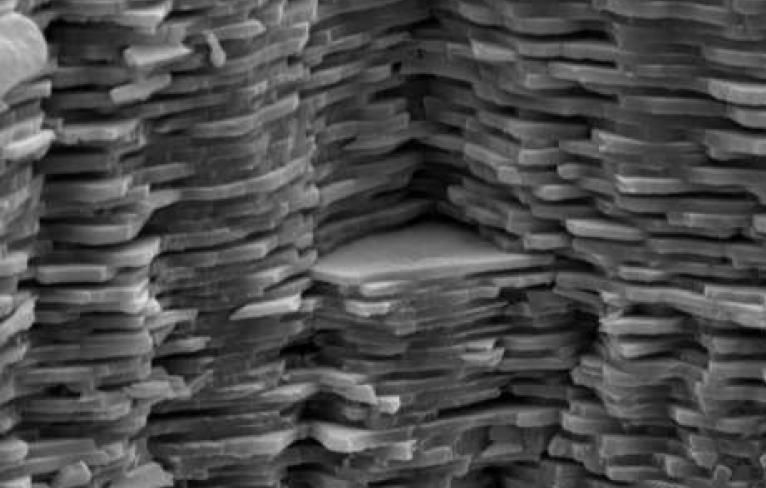

It is mostly mineral. French Polynesia’s pearl law puts the nacre of Tahitian cultured pearls at about 92% aragonite and 6% conchiolin, with the rest mineral salts and water.2
Nacre up close
- Flat platelets of aragonite
- Thin organic layers of conchiolin between them
Nacre over a bead
- The oyster grows only the outer nacre
- Nacre thickness is measured from the bead to the surface
Text version of this diagram
The first drawing shows nacre greatly magnified: rows of small, flat aragonite platelets stacked like bricks in a wall, each row offset from the one below, with a thin colored line between the rows for the organic layer of conchiolin. The second drawing shows a bead-cultured pearl cut in half: a large shell bead in the middle, a band of nacre rings around it, and a bracket across the band marking the nacre’s thickness, from the surface of the bead to the surface of the pearl.
Almost any mollusk can produce a pearl-like object, which scientists call a calcareous concretion, but the pearls valued as gems come from species that secrete nacre.4
How nacre gives pearls their glow#
A pearl’s luster comes from light reflecting off its surface and off the concentric layers of nacre inside it.5 CIBJO’s guide explains that when the aragonite crystals are large, dense and stacked regularly in many layers, light produces the deep luster characteristic of pearls, and that luster is closely related to the thickness of the nacre.6
The layers also make color. Light interfering in the nacre’s thin layers produces the iridescent orient of some pearls,1 and depending on the thickness of the layers, a pearl may show pink or green interference colors.6 The page pearl color explains more.
Polishing can make a pearl’s surface shine like a mirror, but CIBJO notes that this improves only the reflection from the surface, not the deep, soft luster that comes from within the nacre.6 The page luster explains how it is graded.
Pearl or mother-of-pearl?#
Mother-of-pearl is the smooth, hard, iridescent lining of the inner shell, which scientists call nacre.1 A pearl is a separate formation, laid down layer by layer inside a pearl sac within the mollusk’s body.1 Usually, but not always, natural pearls have the same color, composition and general quality as the mother-of-pearl of the mollusk that made them.1
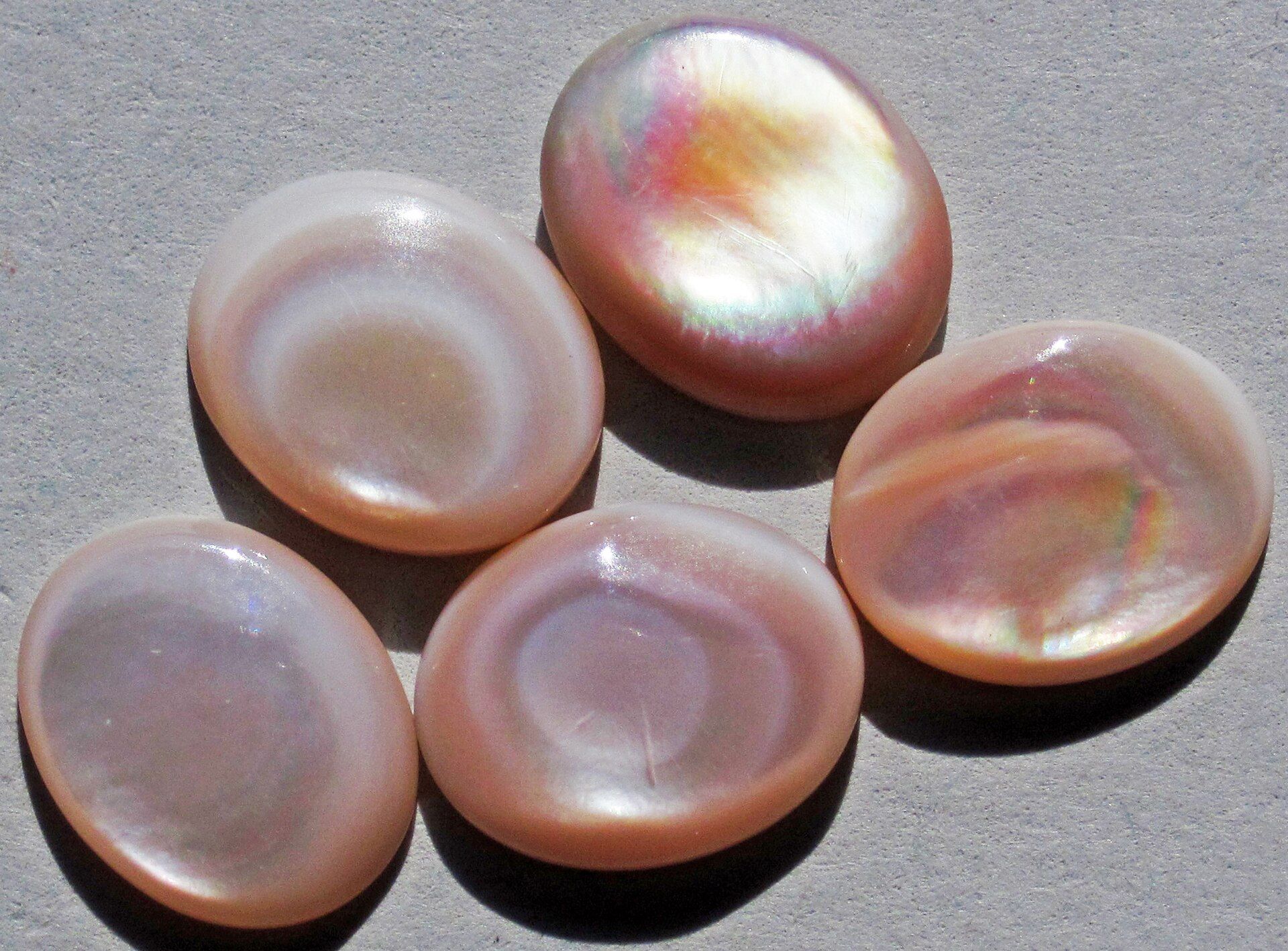

Mother-of-pearl has uses of its own. CIBJO’s guide rates the mother-of-pearl of Pinctada maxima above that of any other pearl oyster for quality, thickness and value, and says it supplies most of the world’s demand for products such as watch faces and jewelry. The black-lipped oyster’s dark mother-of-pearl is used for inlay and buttons, while the shells of the freshwater mussels used for pearls in China have little luster and no ornamental value.6 In Western Australia, the shell is sold for jewelry and buttons alongside the pearls.7 Abalone shell is used as mother-of-pearl too, with nacre in many hues of blue, green, cream, red and purple.1
Nacre thickness#
On a bead-cultured pearl, the oyster grows only the nacre over the bead, so its thickness matters. CIBJO defines nacre thickness as the average thickness of the nacre over the bead, in millimeters. It applies only to beaded cultured pearls, and it is not the same as nacre quality.1
Nacre thickness is closely related to how long the pearl was cultured, and it can affect the pearl’s color, luster and durability.1 GIA says a bead visible under the nacre, or a dull, chalky look, means the nacre is thin.8
It varies widely. In one X-ray image GIA published, a 6.85 mm Akoya had about 0.34 mm of nacre and an 11.15 mm South Sea pearl about 1.92 mm.3 The typical range for South Sea bead-cultured pearls is between 1.5 and 3.0 mm.9 French Polynesia required at least 0.8 mm on Tahitian cultured pearls from 2005 until its 2017 pearl law made the check voluntary.2 10
Labs measure nacre thickness with X-rays. GIA uses real-time microradiography when the nacre looks thin or a client asks.11
Pearls without nacre#
Not every pearl is nacreous. Clam, conch, Melo, scallop and some pen pearls are natural pearls without a nacreous surface.1 A conch pearl, for example, is calcium carbonate arranged in a crossed lamellar structure, which usually gives it a flame-like surface pattern and a porcelain-like sheen.1 The page pearl-producing mollusks covers these pearls and the animals that make them.
Questions people ask#
What's the difference between a pearl and mother-of-pearl?
Both are nacre. Mother-of-pearl is the nacre lining the inside of the shell, while a pearl is a separate formation that grew in layers inside the mollusk's body, in a pearl sac. Natural pearls usually match the color and quality of their mollusk's mother-of-pearl.1
Is mother-of-pearl a real pearl?
No. Mother-of-pearl is shell lining, cut and used for things such as watch faces, jewelry, inlay and buttons. US rules say the term "Mother of Pearl" may not describe an imitation pearl unless it is preceded by "imitation", "artificial" or "simulated".6 12
How thick should nacre be?
Requirements differ. French Polynesia required at least 0.8 mm on Tahitian cultured pearls from 2005 until 2017, and South Sea pearls typically have 1.5 to 3.0 mm. GIA says a bead visible under the nacre, or a dull, chalky look, means the nacre is thin.8 9 10
Do all pearls have nacre?
No. Clam, conch, Melo, scallop and some pen pearls are natural pearls without a nacreous surface. A conch pearl's crossed lamellar structure usually gives it a flame-like pattern and a porcelain-like sheen instead.1
References#
- CIBJO, The World Jewellery Confederation, Pearl Commission (2026). The CIBJO Pearl Book (Pearl Blue Book) 2026. Source · Archived copy (accessed 2026-10-25)
- Assemblée de la Polynésie française (Journal officiel de la Polynésie française) (2017). Loi du pays n° 2017-16 du 18 juillet 2017 réglementant les activités professionnelles liées à la production et la commercialisation des produits perliers et nacriers en Polynésie française. Source · Archived copy (accessed 2026-10-25)
- Chunhui Zhou and W. Henry Towbin (2024). Applications of X-Ray Radiography and X-Ray Computed Microtomography in Gemology. Source · DOI 10.5741/GEMS.60.4.582 · Archived copy (accessed 2026-10-25)
- Changbo Zhu, Paul C. Southgate and Ting Li (2019). Production of Pearls. Source · DOI 10.1007/978-3-319-96776-9_5 · Archived copy (accessed 2026-10-25)
- Gemological Institute of America (GIA), Gem Encyclopedia. Pearl. Source · Archived copy (accessed 2026-10-25)
- CIBJO Pearl Commission (2025). CIBJO Guides Describing and Classifying Natural and Cultured Pearls, the Producing Molluscs & Responsible Pearling. Source · Archived copy (accessed 2026-10-25)
- Department of Primary Industries and Regional Development, Government of Western Australia. Pearl oyster fishery in Western Australia. Source · Archived copy (accessed 2026-10-25)
- Gemological Institute of America (GIA), Gem Encyclopedia. Pearl Quality Factors. Source · Archived copy (accessed 2026-10-25)
- Nanthaporn Nilpetploy, Kwanreun Lawanwong, Promlikit Kessrapong, Areeya Manustrong and Nicholas Sturman (2021). A study on improving the surface appearance of low-quality Pinctada maxima bead cultured pearls. Source · Archived copy (accessed 2026-10-25)
- Chambre territoriale des comptes de la Polynésie française (2021). Rapport d'observations définitives : Politique publique en matière des ressources marines (perliculture), exercices 2015 et suivants. Source · Archived copy (accessed 2026-10-25)
- Gemological Institute of America (GIA), Analysis & Grading. How GIA Identifies and Classifies Pearls. Source · Archived copy (accessed 2026-10-25)
- U.S. Federal Trade Commission (Electronic Code of Federal Regulations). 16 CFR Part 23, Guides for the Jewelry, Precious Metals, and Pewter Industries. Source · Archived copy (accessed 2026-10-25)
- Written by
- Learn About Pearls editors
- Fact-checked
- Learn About Pearls editors,
- Reviewed by
- Simon,
- First published
- Publisher
- Unique Pearl, a pearl jeweler
Revision history
- : First published. First published
How to cite this page
- APA
- Learn About Pearls editors. (2026). What Is Nacre, or Mother-of-Pearl? Learn About Pearls. https://learnaboutpearls.com/basics/nacre/
- MLA
- “What Is Nacre, or Mother-of-Pearl?” Learn About Pearls, Unique Pearl, November 4, 2026, learnaboutpearls.com/basics/nacre/.
- Chicago
- Learn About Pearls editors. “What Is Nacre, or Mother-of-Pearl?” Learn About Pearls. Unique Pearl. Last modified November 4, 2026. https://learnaboutpearls.com/basics/nacre/.
- BibTeX
@misc{lap-basics-nacre, title = {What Is Nacre, or Mother-of-Pearl?}, author = {{Learn About Pearls editors}}, year = {2026}, howpublished = {\url{https://learnaboutpearls.com/basics/nacre/}}, note = {Learn About Pearls, published by Unique Pearl}}
Quoting with attribution and a link is welcome. See how to cite and reuse.