How Do Pearl Farms Work?
Short answerA pearl farm raises or collects oysters or mussels, has a technician implant a piece of mantle tissue, with a shell bead for most saltwater pearls, and tends the animals in the water until the cultured pearls are harvested. Production typically has five stages: oyster selection, nucleus implantation, nurturing, harvesting and processing. Most saltwater oysters grow one pearl at a time, while a freshwater mussel grows dozens.
- Cultured pearl production typically has five stages, oyster selection, nucleus implantation, nurturing, harvesting and processing, and implantation is the key step.1
- For a saltwater pearl, a graft of mantle tissue about 3 × 3 mm goes into the host oyster's gonad together with a polished shell bead.1
- Implanted oysters and mussels rest for at least 2 weeks, a critical period for deaths and bead rejection.1
- Akoya and South Sea oysters grow one pearl at a time, and a South Sea oyster can be re-implanted to produce up to four pearls in all.1
- A freshwater mussel usually produces 30 to 40 pearls at a time.2
- More than 90% of cultured pearls can't be used in jewelry straight from the harvest.1
- Western Australia's wild pearl oyster fishery has 14 licence holders, who collect oysters under a yearly quota.3
On this page
A pearl farm doesn’t make pearls; living oysters and mussels do. The farm’s job is to choose healthy animals, start a cultured pearl inside each one, and look after them until harvest. Cultured pearl production typically has five stages: oyster selection, nucleus implantation, nurturing, harvesting and pearl processing.1
Text version of this diagram
Five numbered steps, one under another. First, choosing the oysters or mussels: they are collected from the wild, bred in a hatchery, or grown from wild spat. Second, implanting the nucleus: a saltwater oyster gets a piece of mantle tissue and a polished shell bead, and a freshwater mussel usually gets pieces of mantle tissue alone. Third, nurturing: after a rest, the animals go back into calm water, where they are kept healthy and free of parasites. Fourth, harvesting, preferably when the water is cold, because nacre then forms more slowly and gives a smoother surface; a pearl oyster grows one pearl at a time, and a freshwater mussel dozens. Fifth, processing: sorting and cleaning, with bleaching, whitening and coloring routine for Akoya and freshwater pearls. An arrow loops from harvesting back to implanting, because an oyster that produced a good South Sea pearl can be given a new bead and go back into the water, up to four pearls in all.
1. Choosing the oysters or mussels#
Pearl farms get their mollusks in two ways. Some collect them from the wild, as in Australia and French Polynesia, as adults or juveniles. Others raise young oysters, called spat, in hatcheries, or catch wild larvae as they settle on collectors placed in the water.1
- Wild oysters. Western Australia has the only significant wild-stock pearl oyster fishery in the world. Divers hand-pick wild Pinctada maxima from the seabed, with the main grounds near Broome.3 Wild oysters make up about 70% of Australia’s South Sea pearl production.2
- Hatchery oysters. Most Akoya oysters are bred in hatcheries,2 and all the P. maxima used in Indonesia, Myanmar and Vietnam are now reared in hatcheries.2 Hatcheries in Broome and Darwin supply young oysters to Australian farms.3
- Wild spat. French Polynesia grows its black-lipped oysters from spat collected in the lagoons.2
The young animals take time to grow. Pearl oyster larvae need at least a year and a half to reach a size suitable for pearl production, while freshwater mussels are ready within a year. The water must be clean and of a suitable temperature, with few harmful organisms, little fouling and few predators.1
2. Implanting the nucleus#
Implantation is the key step. For a saltwater pearl, a technician cuts a tiny piece of mantle tissue, the graft, called saibo in Japanese and about 3 × 3 mm, from a donor oyster.1 It goes into the gonad of the host oyster together with a polished shell bead.1 The donor oyster is sacrificed for its tissue.4
Freshwater pearls usually need no bead. The technician inserts several pieces of mantle tissue alone into the host mussel’s mantle.4 Oysters and mussels are often conditioned before the operation, and their size and age, the size of the bead and the grafting method all affect how many survive and keep their beads.1
In Western Australia, technicians often seed the oysters on board the pearling boats that collect them.3
3. Nurturing the oysters#
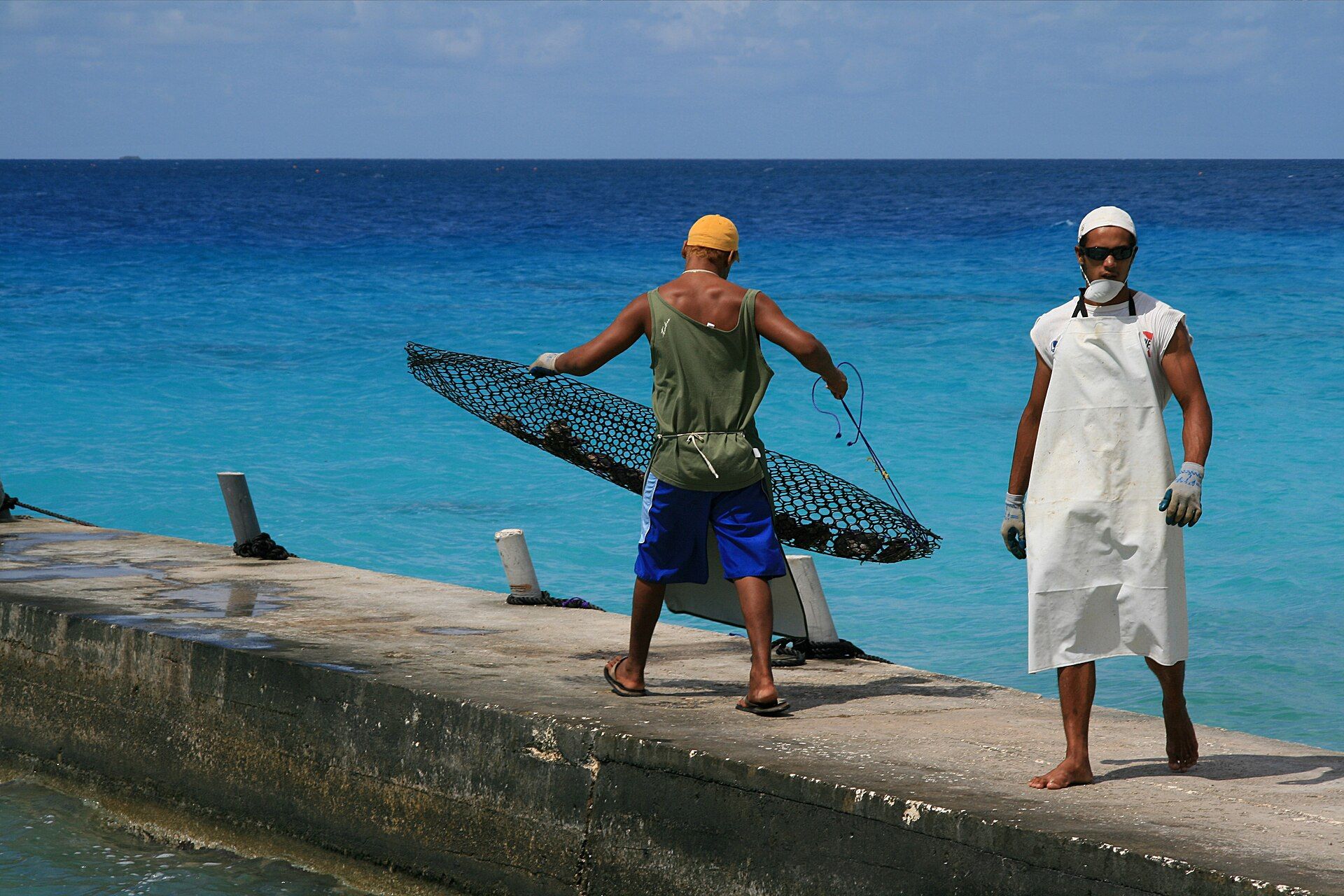
After the operation, implanted oysters and mussels rest for at least 2 weeks, a critical period for deaths and for rejection of the bead.1 They then go back into calm water at a depth of 2 to 3 m, and the water temperature has to be right for them to survive.1
On Western Australian farms, the seeded oysters first go back to the seabed in net panels, which are turned regularly for three months to help the pearls grow round. They then move to sheltered farm waters, hung from floating lines.3
Tending the oysters means keeping them healthy and free of stress, because stress can cause a blemish on the pearl. Crews regularly remove parasites. Each healthy oyster also hosts a tiny pea crab, which probably helps keep it clean, so technicians take care not to harm it.3

4. Harvesting the pearls#
Farms prefer to harvest when the water is cold. Nacre then forms more slowly, which gives a smoother, more lustrous surface.1 The page how long pearls take to grow gives the timings for each type.
Saltwater oysters such as Akoya and South Sea oysters grow one pearl at a time. An oyster that produces a high-quality South Sea pearl is often given a new, larger bead and returned to the water for another 2 to 3 years, and one oyster can produce up to four pearls this way.1
Freshwater mussels yield far more. Up to 20 grafts fit in each of a mussel’s two mantle lobes,1 and a mussel usually produces 30 to 40 non-beaded pearls at a time.2
5. Processing the pearls#
Most pearls need work after the harvest. Because of variations in color and surface defects, more than 90% of cultured pearls can’t be used in jewelry straight from the harvest.1 Processing can include sorting, degreasing, cleaning, bleaching, whitening and coloring, and it is routine for Akoya and freshwater pearls. Luster can also be improved by polishing, with solvents or with materials such as beeswax.1
South Sea pearls are generally not treated in their countries of origin beyond washing and polishing, though some Japanese pearl companies treat them.1 Under CIBJO’s standards, treatments must be declared at the point of sale.5 The page ethics and sustainability looks at farming’s wider effects.
Questions people ask#
How many pearls does one oyster make?
Akoya and South Sea oysters grow one pearl at a time, in the gonad. A good South Sea oyster can be given a new, larger bead after each harvest and produce up to four pearls in all. Freshwater mussels are different. They can take up to 20 grafts in each of their two mantle lobes, and usually produce 30 to 40 pearls at a time.1 2
Do pearl farms use wild oysters?
Some do. Australia's South Sea pearl farms rely mostly on wild oysters collected by divers, about 70% of production, and French Polynesia grows its oysters from wild spat caught in the lagoons. Most Akoya oysters, and the South Sea oysters of the Philippines and Indonesia, are bred in hatcheries.2
Who implants the beads?
Skilled technicians. In Western Australia, technicians seed the oysters, often on board the pearling boats that collect them.3 4
What happens to pearls after the harvest?
Most need some work. More than 90% of cultured pearls can't be used in jewelry straight from the harvest. Processing can include sorting, cleaning, bleaching, whitening and coloring, and it is routine for Akoya and freshwater pearls. South Sea pearls are generally only washed and polished in their countries of origin.1
References#
- Changbo Zhu, Paul C. Southgate and Ting Li (2019). Production of Pearls. Source · DOI 10.1007/978-3-319-96776-9_5 · Archived copy (accessed 2026-10-25)
- CIBJO Pearl Commission (2025). CIBJO Guides Describing and Classifying Natural and Cultured Pearls, the Producing Molluscs & Responsible Pearling. Source · Archived copy (accessed 2026-10-25)
- Department of Primary Industries and Regional Development, Government of Western Australia. Pearl oyster fishery in Western Australia. Source · Archived copy (accessed 2026-10-25)
- Gemological Institute of America (GIA), Gem Encyclopedia. Pearl Description. Source · Archived copy (accessed 2026-10-25)
- CIBJO, The World Jewellery Confederation, Pearl Commission (2026). The CIBJO Pearl Book (Pearl Blue Book) 2026. Source · Archived copy (accessed 2026-10-25)
- Written by
- Learn About Pearls editors
- Fact-checked
- Learn About Pearls editors,
- Reviewed by
- Simon,
- First published
- Publisher
- Unique Pearl, a pearl jeweler
Revision history
- : First published. First published
How to cite this page
- APA
- Learn About Pearls editors. (2026). How Do Pearl Farms Work? Learn About Pearls. https://learnaboutpearls.com/farming/how-pearl-farms-work/
- MLA
- “How Do Pearl Farms Work?” Learn About Pearls, Unique Pearl, November 4, 2026, learnaboutpearls.com/farming/how-pearl-farms-work/.
- Chicago
- Learn About Pearls editors. “How Do Pearl Farms Work?” Learn About Pearls. Unique Pearl. Last modified November 4, 2026. https://learnaboutpearls.com/farming/how-pearl-farms-work/.
- BibTeX
@misc{lap-farming-how-pearl-farms-work, title = {How Do Pearl Farms Work?}, author = {{Learn About Pearls editors}}, year = {2026}, howpublished = {\url{https://learnaboutpearls.com/farming/how-pearl-farms-work/}}, note = {Learn About Pearls, published by Unique Pearl}}
Quoting with attribution and a link is welcome. See how to cite and reuse.