Do Pearls Come From Oysters, Clams or Mussels?
Short answerPearls come from mollusks, and the pearls sold as gems come mostly from pearl oysters in the sea and freshwater mussels in lakes and ponds. Almost any mollusk can make a pearl-like object, but only species that make nacre produce the classic lustrous pearl. Clams, scallops and sea snails such as conchs also produce natural pearls, though theirs have no nacre, and many look porcelain-like instead.
- Almost all mollusk species can produce pearl-like objects, but the pearls valued as gems come from species that secrete nacre.1
- Cultured pearls come from marine pearl oysters of the family Pteriidae and from freshwater pearl mussels of the families Unionidae and Margaritiferidae.1
- Pearl oysters are marine bivalves of the genera Pinctada and Pteria.2
- Over 98% of freshwater pearls come from China, where only about ten of more than 100 freshwater mussel species are used for pearls.1
- Conch pearls have no nacre; their structure usually gives them a flame-like surface pattern and a porcelain-like sheen.2
- The giant clam, Tridacna gigas, the largest and heaviest known mollusk, produces white, porcelain-like pearls.2
On this page
All pearls come from mollusks, but not all mollusks make the pearls used in jewelry. Almost every species of mollusk can produce pearl-like objects, which scientists call calcareous concretions. The pearls valued as gems come from species that secrete nacre, the material also known as mother-of-pearl.1
Two groups of mollusks produce almost all cultured pearls: marine pearl oysters of the family Pteriidae, and pearl mussels of the families Unionidae and Margaritiferidae, which live in fresh water.1 The table shows the mollusk behind each main cultured pearl type, from the Learn About Pearls dataset.
| Feature | Akoya cultured pearl | South Sea cultured pearl | Tahitian cultured pearl | Freshwater cultured pearl |
|---|---|---|---|---|
| Mollusk | Pinctada fucata (Akoya pearl oyster)2 3 | Pinctada maxima (silver-lipped pearl oyster and gold-lipped pearl oyster)2 4 | Pinctada margaritifera cumingii (black-lipped pearl oyster)2 5 6 | Hyriopsis cumingii (triangle shell mussel)2 3 7 8 |
| Water | saltwater3 9 | saltwater6 9 | saltwater6 9 | freshwater2 6 |
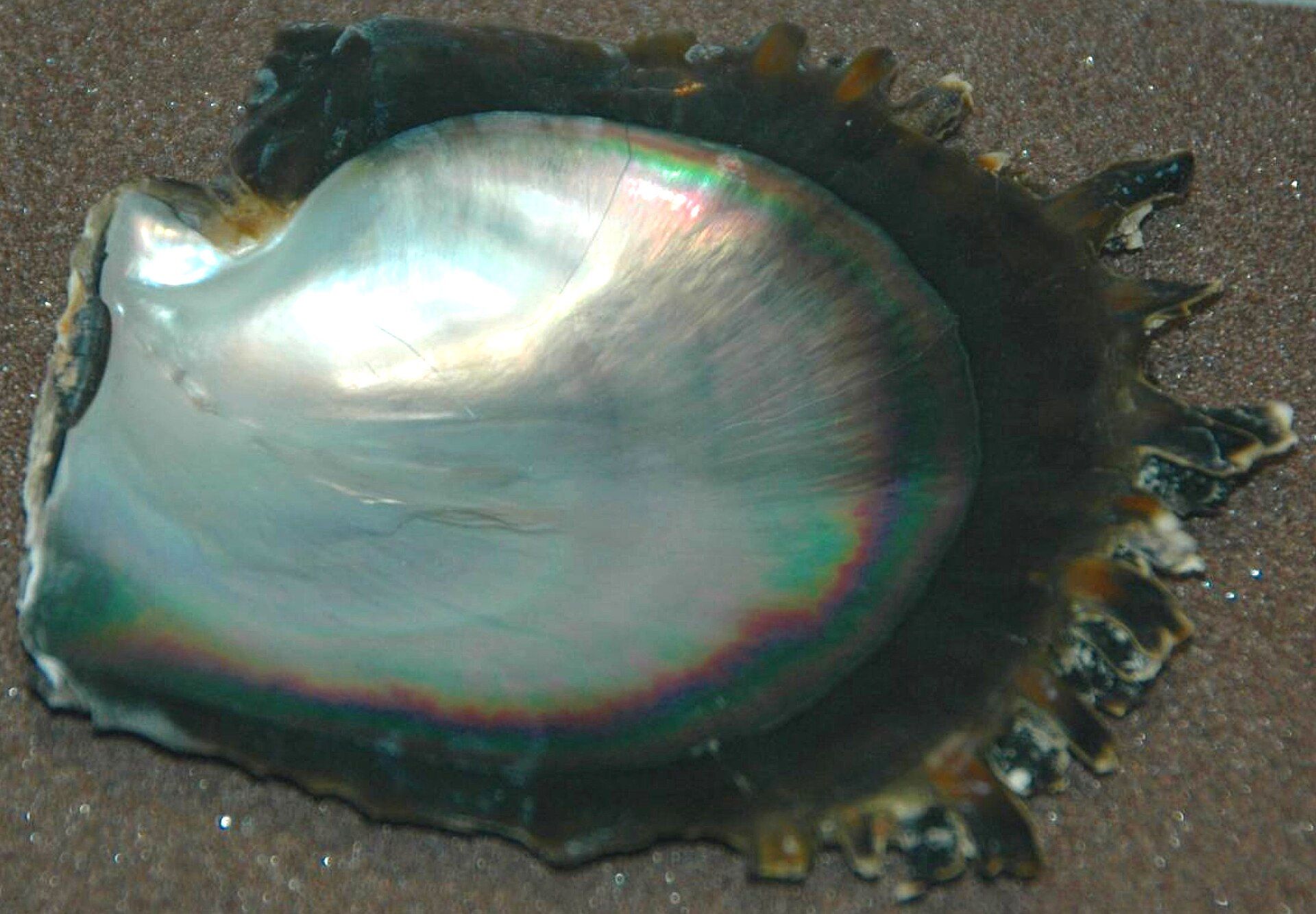
Pearl oysters#
Pearl oysters are marine bivalves of the genera Pinctada and Pteria.2 Several species have been used for pearl production for over a century:1
- Pinctada fucata (P. martensii), the Akoya pearl oyster, one of the smallest pearl-producing oysters, used in Japan and China for Akoya pearls.1
- Pinctada maxima, the largest pearl oyster, with a gold or silver lip, used for South Sea pearls.1
- Pinctada margaritifera, the black-lipped pearl oyster and the second largest, which produces the black pearls of French Polynesia and the Cook Islands, and is also cultured in Fiji.1
- Pteria penguin, the winged or penguin’s wing oyster, used mainly for mabe half-pearls, and Pteria sterna, the rainbow-lipped oyster of Mexico’s Gulf of California, which now produces round and near-round cultured pearls.1
Pinctada radiata produces natural pearls in the Arabian Gulf, which CIBJO calls Bahraini or Basra pearls.2

Freshwater pearl mussels#
Freshwater pearl mussels are farmed in ponds, rivers and lakes. Over 98% of freshwater pearls come from China, and the rest from countries including Japan, Australia and Vietnam.1
China has more than 100 species of freshwater mussels, but only about ten are used for pearls.1 The most productive is the triangle shell mussel, Hyriopsis cumingii, followed by Cristaria plicata. China has also brought in Hyriopsis schlegelii from Japan and Potamilus alatus from North America, which can produce high-quality black freshwater pearls.1
Ordinary mussels can make pearls too. CIBJO notes that the edible California mussel may contain several pearls.2
Clams, conchs, scallops and other mollusks#
Some mollusks produce natural pearls without a nacreous surface. Clam, conch, Melo, scallop and some pen pearls are all non-nacreous.2
- Clams. The northern quahog, a common North American clam, produces clam pearls in shades of purple. The giant clam, Tridacna gigas, the largest and heaviest known mollusk, produces white, porcelain-like pearls; its two valves can weigh as much as about 225 kg.2
- Conchs. Conch pearls come from large sea snails such as the queen conch, the horse conch and the emperor helmet. Their crossed lamellar structure usually gives them a flame-like surface pattern and a porcelain-like sheen, and they are also called pink pearls.2
- Melo shells. Melo pearls are non-nacreous natural pearls from Melo volutes, a group of large marine snails.2
- Pen shells. Pen pearls come from pen shells, marine bivalves of the family Pinnidae. They can be orange or brown, with or without nacre, or silvery and nacreous.2
- Scallops. Scallop pearls have a surface made of a patchwork of tiny cells, which gives them a sheen of their own.2
- Abalone. Abalone, whose nacre comes in many hues of blue, green, cream, red and purple, produces distinctive natural pearls, and cultured blisters are grown in places such as California and New Zealand.2 Natural abalone pearls are often hollow, and therefore fragile.2
CIBJO’s entries for conch and giant clam pearls point to CITES, the international treaty that controls trade in endangered species.2
How labs tell which mollusk made a pearl#
A pearl often carries signs of its mollusk. Usually, but not always, a natural pearl has the same color, composition and general quality as the mother-of-pearl of the mollusk that produced it.2 Pearls from the black-lipped oyster show a reflectance feature at 700 nm that is a key identifying sign,10 and freshwater pearls contain more manganese and barium and less strontium than saltwater pearls.11
A GIA report states which mollusk produced a pearl when that can be determined.3
Questions people ask#
Do clams make pearls?
Yes, but not the nacreous pearls used in most jewelry. Clam pearls are natural pearls without nacre. The northern quahog produces them in shades of purple, and the giant clam produces white, porcelain-like ones.2
Can mussels make pearls?
Yes. Freshwater pearl mussels produce almost all of the world's cultured pearls by weight, mostly in China. Even the edible California mussel may contain several pearls.1 2
What is a conch pearl?
A natural pearl from a large sea snail such as the queen conch. It has no nacre; its calcium carbonate is arranged in a crossed lamellar structure that usually gives it a flame-like surface pattern and a porcelain-like sheen. Conch pearls are also called pink pearls.2
References#
- Changbo Zhu, Paul C. Southgate and Ting Li (2019). Production of Pearls. Source · DOI 10.1007/978-3-319-96776-9_5 · Archived copy (accessed 2026-10-25)
- CIBJO, The World Jewellery Confederation, Pearl Commission (2026). The CIBJO Pearl Book (Pearl Blue Book) 2026. Source · Archived copy (accessed 2026-10-25)
- Phoebe Shang (2026). Freshwater Akoyas – A Trending Misnomer for Certain Freshwater Pearls. Source · Archived copy (accessed 2026-10-25)
- Artitaya Homkrajae, Nanthaporn Nilpetploy, Areeya Manustrong, Nicholas Sturman, Kwanreun Lawanwong and Promlikit Kessrapong (2021). Internal Structures of Known Pinctada maxima Pearls: Cultured Pearls from Operated Marine Mollusks. Source · DOI 10.5741/GEMS.57.3.186 · Archived copy (accessed 2026-10-25)
- Assemblée de la Polynésie française (Journal officiel de la Polynésie française) (2017). Loi du pays n° 2017-16 du 18 juillet 2017 réglementant les activités professionnelles liées à la production et la commercialisation des produits perliers et nacriers en Polynésie française. Source · Archived copy (accessed 2026-10-25)
- Gemological Institute of America (GIA), Gem Encyclopedia. Pearl Description. Source · Archived copy (accessed 2026-10-25)
- CIBJO Pearl Commission (2025). CIBJO Guides Describing and Classifying Natural and Cultured Pearls, the Producing Molluscs & Responsible Pearling. Source · Archived copy (accessed 2026-10-25)
- Doug Fiske and Jeremy Shepherd (2007). Continuity and Change in Chinese Freshwater Pearl Culture. Source · DOI 10.5741/GEMS.43.2.138 · Archived copy (accessed 2026-10-25)
- Gemological Institute of America (GIA), FAQ. What are the main types of cultured pearls and what are their distinctive characteristics?. Source · Archived copy (accessed 2026-10-25)
- Artitaya Homkrajae (2016). Spectral Characteristics of Pinctada mazatlanica and Pinctada margaritifera Pearl Oyster Species. Source · Archived copy (accessed 2026-10-25)
- Stefanos Karampelas and others (2019). Chemical Characteristics of Freshwater and Saltwater Natural and Cultured Pearls from Different Bivalves. Source · DOI 10.3390/min9060357 · Archived copy (accessed 2026-10-25)
- Gemological Institute of America (GIA), Gem Encyclopedia. Pearl Buyer's Guide. Source · Archived copy (accessed 2026-10-25)
- Written by
- Learn About Pearls editors
- Fact-checked
- Learn About Pearls editors,
- Reviewed by
- Simon,
- First published
- Publisher
- Unique Pearl, a pearl jeweler
Revision history
- : First published. First published
How to cite this page
- APA
- Learn About Pearls editors. (2026). Do Pearls Come From Oysters, Clams or Mussels? Learn About Pearls. https://learnaboutpearls.com/science/pearl-producing-mollusks/
- MLA
- “Do Pearls Come From Oysters, Clams or Mussels?” Learn About Pearls, Unique Pearl, November 4, 2026, learnaboutpearls.com/science/pearl-producing-mollusks/.
- Chicago
- Learn About Pearls editors. “Do Pearls Come From Oysters, Clams or Mussels?” Learn About Pearls. Unique Pearl. Last modified November 4, 2026. https://learnaboutpearls.com/science/pearl-producing-mollusks/.
- BibTeX
@misc{lap-science-pearl-producing-mollusks, title = {Do Pearls Come From Oysters, Clams or Mussels?}, author = {{Learn About Pearls editors}}, year = {2026}, howpublished = {\url{https://learnaboutpearls.com/science/pearl-producing-mollusks/}}, note = {Learn About Pearls, published by Unique Pearl}}
Quoting with attribution and a link is welcome. See how to cite and reuse.