What Are Your Inherited Pearls, and Are They Valuable?
Short answerStart by finding out what they are. An old strand may be imitation, cultured or natural, and age alone doesn't settle it, because cultured pearls have been commercially important since the 1920s. Simple tests expose many imitations, but only a gem laboratory, using X-rays, can confirm that pearls are natural. Value then depends on the usual quality factors and on condition, and an old strand may need restringing, since string stretches and weakens.
- Cultured pearls have been commercially important since the 1920s, so an old strand is not necessarily natural.1
- Imitation pearls have a long history too; one Spanish maker was producing them by the early 1900s and sold them as "Spanish pearls" until 1939.2
- In a GIA study, cultured pearls felt gritty against the teeth and imitations smooth, but the test can damage pearls and a gritty feel doesn't rule out every imitation.2
- A laboratory tells natural pearls from cultured ones with X-ray imaging of their inner structure.3
- SSEF's reports give the position of any cultured pearl found in a necklace of natural pearls.4
- Aging, dehydration and sometimes heavy bleaching during processing can make some pearls more fragile.5
- All natural and cultured pearls are known to change their color appearance over time.6
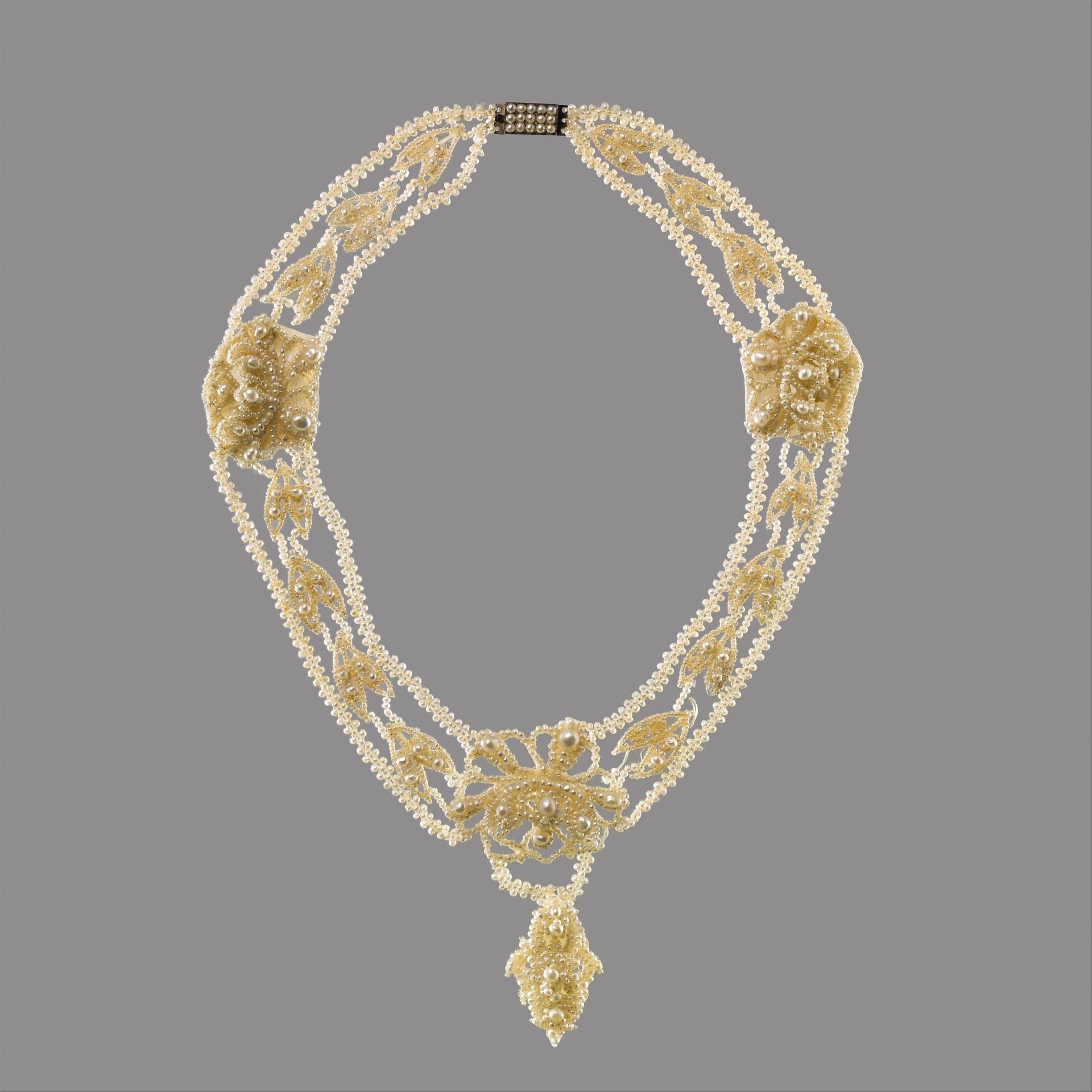
Pearls have long been family treasures: royal families and wealthy citizens in Asia, Europe and elsewhere passed natural pearls down from generation to generation.1 If you have inherited a strand, three questions come first: are they pearls at all, are they natural or cultured, and what condition are they in?
Text version of this diagram
Four boxes in a column, joined by arrows. First, are they pearls at all? Simple checks help, and a laboratory report states what they are. Second, are they natural or cultured? Age doesn’t settle it; a laboratory looks inside with X-rays. Third, what condition are they in? Older pearls can be more fragile, so check the string and how they are stored. Last, what are they worth? The seven quality factors decide, and whether the pearls are natural matters a great deal.
Pearls or imitations?#
An imitation pearl is a manufactured product that only looks like a pearl.7 Imitations have a long history. One Spanish maker was producing imitation pearls in the early 1900s, moved its factory to Majorca in 1920, and before 1939 sold all its pearls simply as “Spanish pearls.”2
In GIA’s study of those imitations, four tests were conclusive. One was the tooth test: rubbed gently against the edge of the front teeth, cultured pearls felt gritty and the imitations smooth. The authors warned that the test can damage pearls, and that a gritty feel doesn’t rule out every imitation. Another was a ten-power loupe at the drill hole: a cultured pearl showed a thin, often dark layer between the bead and the nacre, with sharp edges at the hole.2 The page how to tell if pearls are real explains these and other tests.
Natural or cultured?#
Age alone doesn’t settle it. Cultured pearls have been commercially important since the 1920s,1 and the first gem laboratories, from 1925 on, initially focused on telling natural and cultured pearls apart.8
A laboratory does it with X-rays. On an X-ray image, a natural pearl shows no bead or curved cavity at its center and a uniform, onion-like structure.3 The page natural vs cultured pearls explains the differences.
A laboratory report states what the pearls are. SSEF’s pearl reports say whether pearls are natural or cultured, beaded or beadless, and from salt water or fresh water, and they note treatments that affect color. A strand can mix the two, and SSEF’s reports give the position of any cultured pearl found in a necklace of natural pearls, counted from the clasp.4
Natural pearls are also weighed. SSEF gives the weight of natural pearls in carats and in grains, where 1 grain is 0.25 carat.4
Condition#
Older pearls need gentle handling. GIA notes that aging, dehydration and sometimes heavy bleaching during processing can make some pearls more fragile.5
Color can change as well. CIBJO’s guide notes that, because pearls are made by living animals, all natural and cultured pearls are known to change their color appearance over time.6
The string wears out too. Over the years it stretches and weakens, and a strand that shows too much string can easily be restrung.9 The page restringing pearls explains when and why.
Storage matters too. Never keep pearls in a plastic bag, which can give off a chemical that damages their surface,10 and remember that storing them somewhere very dry, such as a safe deposit box, can sometimes do more harm than good, because pearls draw moisture from the air.11
What affects their value#
The same seven factors apply to old pearls as to new ones: size, shape, color, luster, surface quality, nacre quality and matching.12 Whether pearls are natural matters a great deal, because natural pearls are rare: hundreds of oysters or mussels must be opened to find even one.3
History can matter too. When Sotheby’s sold jewels from the Bourbon Parma family in Geneva in 2018, the ten pieces from Marie Antoinette’s collection reached CHF 43.1 million against a pre-sale estimate of CHF 1.6 to 2.9 million, and her natural pearl and diamond pendant set a record for a natural pearl at CHF 36,427,000.13
A laboratory report confirms what the pearls are, which is the first step to knowing what they are worth. The page what pearls are worth explains what drives prices.
Questions people ask#
Are old pearls always natural?
No. Cultured pearls have been commercially important since the 1920s, and imitations were being made in Spain by the early 1900s. Only a laboratory can say for certain whether pearls are natural.1 2 8
How can I tell if my pearls are real?
Some simple tests help. In a GIA study, cultured pearls felt gritty when rubbed gently against the front teeth and imitations smooth, and a loupe at the drill hole showed a thin, often dark layer between bead and nacre in cultured pearls. But the tooth test can damage pearls, and only a laboratory can confirm what they are.2
Are inherited pearls worth anything?
That depends on what they are and their condition. Natural pearls are rare, and the most important can sell for millions; at Sotheby's in 2018, Marie Antoinette's natural pearl pendant sold for CHF 36,427,000. Cultured pearls are judged on the same seven value factors as new ones. A laboratory report, which confirms what the pearls are, is the first step.3 12 13
Should I restring my grandmother's pearls?
If the string has stretched, yes. Over the years the string on a strand stretches and weakens, and pearls can easily be restrung. GIA also notes that age and dehydration can make some pearls more fragile, so handle an old strand gently.5 9
Can old pearls change color?
Yes. CIBJO's guide notes that, because they are made by living animals, all natural and cultured pearls are known to change their color appearance over time.6
References#
- Gemological Institute of America (GIA), Gem Encyclopedia. Pearl History and Lore. Source · Archived copy (accessed 2026-10-25)
- June Hanano, Mary Wildman and Philip G. Yurkiewicz (1990). Majorica Imitation Pearls. Source · DOI 10.5741/GEMS.26.3.178 · Archived copy (accessed 2026-10-25)
- Changbo Zhu, Paul C. Southgate and Ting Li (2019). Production of Pearls. Source · DOI 10.1007/978-3-319-96776-9_5 · Archived copy (accessed 2026-10-25)
- Swiss Gemmological Institute SSEF. Pearls (SSEF reports). Source · Archived copy (accessed 2026-10-25)
- Gemological Institute of America (GIA), Gem Encyclopedia. Pearl Care and Cleaning Guide. Source · Archived copy (accessed 2026-10-26)
- CIBJO Pearl Commission (2025). CIBJO Guides Describing and Classifying Natural and Cultured Pearls, the Producing Molluscs & Responsible Pearling. Source · Archived copy (accessed 2026-10-25)
- U.S. Federal Trade Commission (Electronic Code of Federal Regulations). 16 CFR Part 23, Guides for the Jewelry, Precious Metals, and Pewter Industries. Source · Archived copy (accessed 2026-10-25)
- Chunhui Zhou and W. Henry Towbin (2024). Applications of X-Ray Radiography and X-Ray Computed Microtomography in Gemology. Source · DOI 10.5741/GEMS.60.4.582 · Archived copy (accessed 2026-10-25)
- Gemological Institute of America (GIA), Gem Encyclopedia. Pearl Buyer's Guide. Source · Archived copy (accessed 2026-10-25)
- Gemological Institute of America (GIA), Birthstones. June Birthstones. Source · Archived copy (accessed 2026-10-25)
- Gemological Institute of America (GIA), News & Research (2015). Tips on Caring for Jewelry. Source · Archived copy (accessed 2026-10-26)
- Gemological Institute of America (GIA), Gem Encyclopedia. Pearl Quality Factors. Source · Archived copy (accessed 2026-10-25)
- Sotheby's (2018). Marie Antoinette's Pearls Break Auction Records in Geneva. Source · Archived copy (accessed 2026-10-25)
- Written by
- Learn About Pearls editors
- Fact-checked
- Learn About Pearls editors,
- Reviewed by
- Simon,
- First published
- Publisher
- Unique Pearl, a pearl jeweler
Revision history
- : First published. First published
How to cite this page
- APA
- Learn About Pearls editors. (2026). What Are Your Inherited Pearls, and Are They Valuable? Learn About Pearls. https://learnaboutpearls.com/owning/inherited-and-antique-pearls/
- MLA
- “What Are Your Inherited Pearls, and Are They Valuable?” Learn About Pearls, Unique Pearl, November 4, 2026, learnaboutpearls.com/owning/inherited-and-antique-pearls/.
- Chicago
- Learn About Pearls editors. “What Are Your Inherited Pearls, and Are They Valuable?” Learn About Pearls. Unique Pearl. Last modified November 4, 2026. https://learnaboutpearls.com/owning/inherited-and-antique-pearls/.
- BibTeX
@misc{lap-owning-inherited-and-antique-pearls, title = {What Are Your Inherited Pearls, and Are They Valuable?}, author = {{Learn About Pearls editors}}, year = {2026}, howpublished = {\url{https://learnaboutpearls.com/owning/inherited-and-antique-pearls/}}, note = {Learn About Pearls, published by Unique Pearl}}
Quoting with attribution and a link is welcome. See how to cite and reuse.